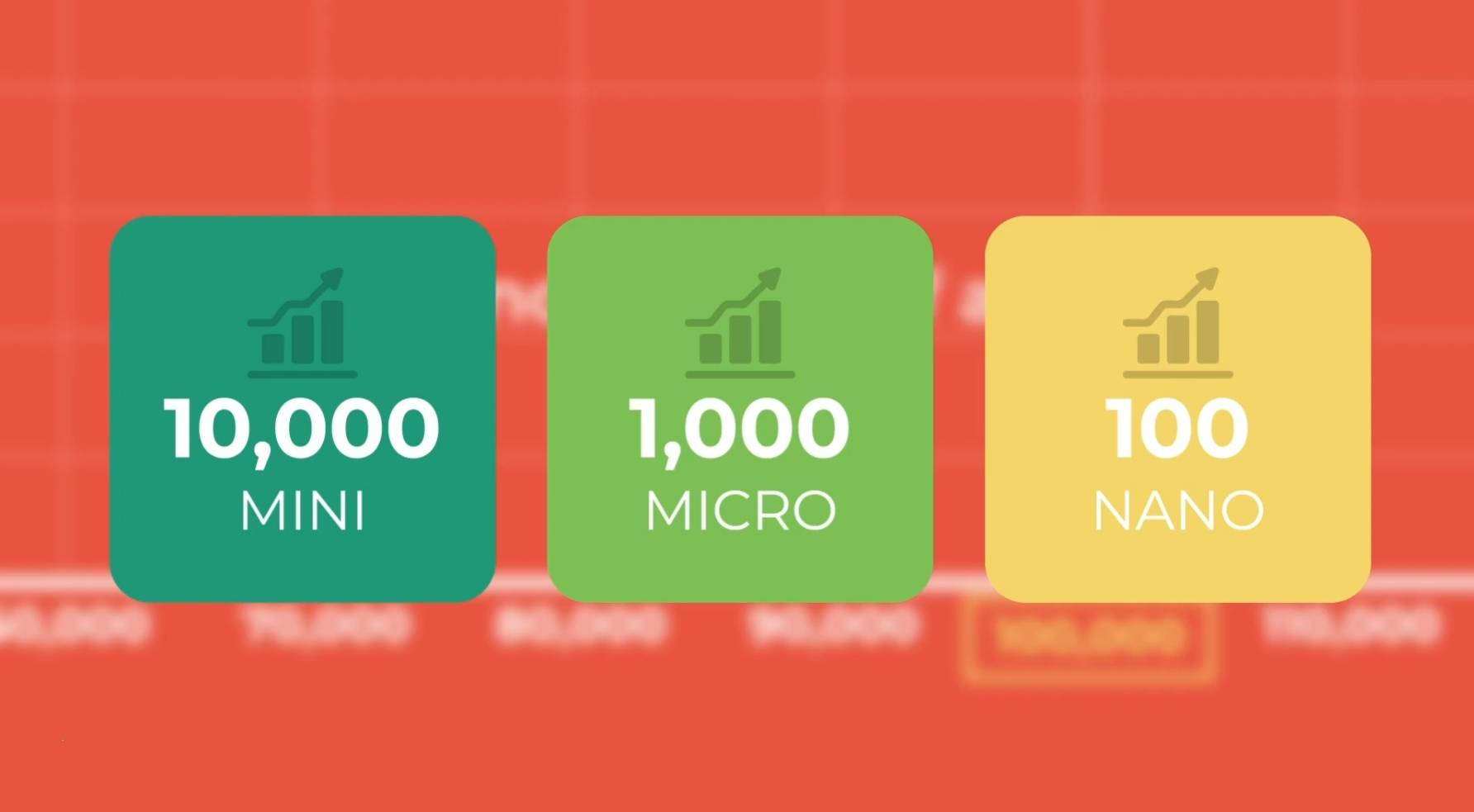
Learn how forex lot size is calculated using margin, leverage, exchange rates, pip value and risk exposure, with examples for position sizing and risk management.
Core Variables in Lot Size Calculation
Margin
Margin is the amount of funds that traders need to freeze in their account when opening a leveraged position. Margin is not a trading cost; it is similar to a security deposit used to cover potential trading losses. The margin amount depends on three factors: trade lot size, contract notional value and leverage ratio.
The relationship between margin and lot size can be summarised as follows: the larger the lot size, the more margin is required. Assuming the leverage ratio and exchange rate remain unchanged, the margin required to trade 2 standard lots is twice the margin required to trade 1 standard lot.
Leverage Ratio
Leverage is a capital amplification tool provided by brokers to traders. Common leverage in the forex market ranges from 1:1, meaning no leverage, to 1:500, while some brokers even offer 1:1000 or higher leverage options. Leverage directly affects margin calculation: the higher the leverage, the less margin is required to open the same lot size.
It is important to clarify that although leverage lowers the entry threshold, it does not change the profit and loss ratio of a trade. It only changes the amount of funds required to open a position. In practice, high leverage means an account can open larger lot sizes, but it also magnifies the impact of adverse price movements on account equity.
Exchange Rate and Contract Unit
The exchange rate is the conversion benchmark when calculating margin and profit or loss. For a USD-denominated account tradingEUR/USD, margin calculation requires converting the quantity of the base currency, the euro, into US dollars at the current exchange rate. The contract unit per lot differs across instruments, making it a parameter that must be confirmed precisely in lot size calculation.
| Variable Name | Typical Value Range | Impact on Lot Size | Calculation Point |
|---|---|---|---|
| Available account margin | Varies by account size | The more margin available, the larger the lot size that can be opened | Used margin and floating losses must be deducted |
| Leverage ratio | 1:1 to 1:500, common range | The higher the leverage, the larger the lot size that can be opened with the same margin | High leverage also amplifies profit and loss risk |
| Current exchange rate | Changes in real time by instrument | The higher the exchange rate, the more margin is required for the same lot size | Real-time exchange rates should be used |
| Contract unit per lot | Forex 100,000; gold 100 ounces, etc. | The larger the unit, the higher the notional value per lot | Must be confirmed separately for different instruments |
| Stop-loss distance, pip | Usually 10 to 200 pips | The wider the stop loss, the smaller the lot size under the same risk | Should be set in combination with instrument volatility |
Steps for Calculating the Maximum Tradable Lot Size
Formula and Process
The formula for calculating the maximum tradable lot size is:
Maximum trade lot size = margin amount × leverage ratio ÷ current exchange rate ÷ units per lot
The complete calculation steps are as follows:
Confirm the trading instrument and current exchange rate, such as EUR/USD at 1.1000
Confirm the available account margin, such as USD 100,000
Confirm the account leverage ratio, such as 1:500
Confirm the contract unit per lot for the instrument, such as 100,000 units for a standard forex lot
Apply the formula: 100,000 × 500 ÷ 1.1000 ÷ 100,000 = 45.45
Result: the theoretical maximum tradable lot size is approximately 45.45 standard lots
Key Considerations
The result above is a theoretical maximum and should not be used directly in actual trading. The reason is that if all available margin is used to open a position, the account will have no buffer at all. Once the market moves slightly against the position, the account may trigger forced liquidation. In practice, traders usually keep actual position size within 5% to 20% of the theoretical maximum to ensure the account has sufficient funds to withstand market volatility.
Lot Size Calculation Based on Risk Exposure
The 1%-2% Risk Management Rule
In trading practice, a more useful lot size calculation method is based on risk exposure rather than maximum margin. Its core principle is that the maximum loss per trade should not exceed 1% to 2% of total account equity. This method is known as the “1% rule” or “2% rule” and is a risk management guideline widely used by professional traders.
The lot size calculation formula based on risk exposure is:
Trade lot size = allowed loss amount ÷ (stop-loss distance in pips × value per pip)
Calculation Example
The following is a complete calculation example:
Set account equity: USD 10,000
Set risk per trade: 2%, meaning maximum allowed loss = 10,000 × 2% = USD 200
Determine the trading instrument: EUR/USD, current exchange rate 1.1000
Set the stop-loss distance based on analysis: 50 pips
Confirm value per pip: the value per pip for 1 standard lot of EUR/USD is approximately USD 10
Calculate lot size: 200 ÷ (50 × 10) = 0.4 standard lot
Result: under these risk parameters, the suggested trade size is 0.4 standard lot, or 40,000 units
Comparison of the Two Calculation Methods
| Calculation Method | Required Parameters | Applicable Scenario | Main Limitation |
|---|---|---|---|
| Maximum margin method | Margin, leverage, exchange rate, contract unit | Assessing the theoretical maximum position capacity of an account | Does not directly reflect risk exposure and has limited practical value |
| Risk exposure method, 1%-2% rule | Account equity, risk ratio, stop-loss distance, pip value | Lot size decisions in daily trading | Requires a reasonable stop-loss distance to be determined in advance |
| Fixed amount risk method | Fixed risk amount, stop-loss distance, pip value | When the trader wants the risk amount to remain consistent for every trade | Does not automatically adjust with account size |
Lot Size Limits Under Different Account Types
Brokers usually set different minimum and maximum lot size limits based on account type and trading instrument. The following table uses common industry lot specifications as examples. Specific parameters vary by broker:
| Account Type | Trading Instrument | Minimum Lot Size | Maximum Lot Size |
|---|---|---|---|
| Standard account | Forex currency pairs | 0.01 lot, 1,000 units | 100 lots, 10,000,000 units |
| Standard account | Stock indexCFD | 0.1 lot | 100 lots |
| Standard account | Precious metals, gold / silver | 0.01 lot | 50 lots |
| Standard account | Energy commodities | 0.1 lot | 20 lots |
| Micro account | Forex currency pairs | 0.1 micro lot, 100 units | 100 micro lots |
| Micro account | Precious metals | 0.01 micro lot | 50 micro lots |
In theMT4orMT5platform, traders can view the contract specifications of a specific instrument as follows: right-click the instrument in the “Market Watch” panel, select “Specification,” and the platform will display details such as contract size, minimum and maximum trade volume,pipdefinition and other parameters.
Practical Points for Choosing Lot Size
Determining Lot Type Based on Account Size
Account size is the primary consideration when determining lot type. The following are reference ranges for lot types under different account sizes:
Account equity below USD 500: consider micro lots, 0.01 lot, or nano lots first. Under the 1%-2% rule, risk exposure per trade should be controlled at USD 5 to USD 10
Account equity between USD 500 and USD 5,000: micro lots to mini lots may be used, with risk exposure per trade controlled at USD 10 to USD 100
Account equity between USD 5,000 and USD 50,000: mini lots to standard lots may be used, with risk exposure per trade controlled at USD 50 to USD 1,000
Account equity above USD 50,000: various lot sizes may be used flexibly, but risk exposure management principles should still be followed
The reference ranges above are only general suggestions. Actual lot size selection should also be determined by combining the trader’s strategy type, holding period and market volatility conditions.
Impact of Stop-Loss Distance on Lot Size
Stop-loss distance has an inverse relationship with lot size, which is one of the core calculation principles in position management. When risk exposure is fixed:
When the stop-loss distance is 20 pips, the calculated lot size is larger
When the stop-loss distance is 100 pips, the calculated lot size is smaller
This means that short-term traders, who usually use narrower stop losses, can open relatively larger lot sizes, while medium- and long-term traders, who usually use wider stop losses, should use smaller lot sizes. From the perspective of risk exposure, the risk per trade is the same for both. The only difference is that stop-loss width and lot size are adjusted inversely.
Risk Avoidance in Lot Size Settings
In actual trading, there are several common risk points around lot size settings that traders should consciously avoid:
Full-margin risk: using all available margin to open the maximum lot size leaves the account with no buffer against market volatility and can easily trigger forced liquidation
Ignoring instrument differences: different instruments have different contract sizes and volatility. Directly applying forex lot sizes to gold or crude oil CFDs may cause actual risk exposure to far exceed expectations
Misjudging leverage risk: high leverage allows large lot sizes to be opened with a small amount of margin, but leverage does not change the profit and loss ratio. It only lowers the entry threshold. High leverage combined with large lot sizes is a common reason for rapid account losses
Lot precision risk: some brokers use a lot precision of 0.01 lot. When the calculated result is 0.015 lot, it should be rounded down to 0.01 lot to ensure actual risk does not exceed the preset amount
Cross-instrument cumulative risk: when holding positions in multiple instruments at the same time, total account risk exposure is the sum of the risks corresponding to each instrument’s lot size, not the risk of a single instrument
“Position sizing is the most important part of any trading system, yet most people completely ignore it when building their systems.”
Questions Related to Trading Lot Size
How can traders view the contract size of a specific instrument in MT4/MT5?
In the MT4 or MT5 platform, open the “Market Watch” window, right-click the instrument to be checked, such as EUR/USD or XAU/USD, and select “Specification” from the menu. In the specification window, traders can view detailed parameters such as the instrument’s contract size, meaning units per lot, minimum and maximum trading volume, margin requirements and pip definition. These parameters are the basic data needed for lot size calculation.
How is the 1% risk management rule applied to lot size calculation?
The core steps of the 1% rule are as follows: first, multiply total account equity by 1% to obtain the maximum allowed loss per trade; then determine the stop-loss distance in pips; next, identify the value per pip for the instrument at the current lot size; finally, divide the allowed loss amount by stop-loss distance × value per pip to obtain the suggested trade lot size. For example: USD 5,000 account × 1% = USD 50 risk, stop loss of 25 pips, EUR/USD pip value of USD 10 per standard lot, so lot size = 50 ÷ (25 × 10) = 0.2 standard lot.
How should lot size be adjusted after leverage changes from 1:100 to 1:500?
Changes in leverage affect margin requirements, but they do not directly affect lot size calculations based on risk exposure. If using the maximum margin method, increasing leverage from 1:100 to 1:500 increases the theoretical maximum lot size that can be opened with the same margin by 5 times. However, if using the 1%-2% risk rule to calculate lot size, the calculation result does not change because of the leverage change. This is because the method is based on risk exposure, meaning stop-loss distance × pip value, rather than margin amount. Traders are advised to continue determining lot size based on the risk exposure method after leverage changes, rather than opening positions according to maximum available margin.
Can different instruments use different lot sizes within the same account?
Yes. The lot size of each instrument is calculated independently. Traders can determine the appropriate lot size for each instrument based on its volatility, stop-loss distance and pip value. For example, EUR/USD may be traded at 0.5 standard lot while a gold CFD is traded at 0.1 standard lot. Each is determined independently based on its instrument characteristics and risk management parameters. It is important to note that when multiple instruments are held at the same time, total account risk exposure is the combined risk of all positions and should be assessed as a whole.