This guide explains margin call concepts, key terms, trigger logic, forced liquidation links, equity changes through examples, leveraged product types, margin risk assessment steps, and practical risk control points.
Basic Concept of Margin Calls
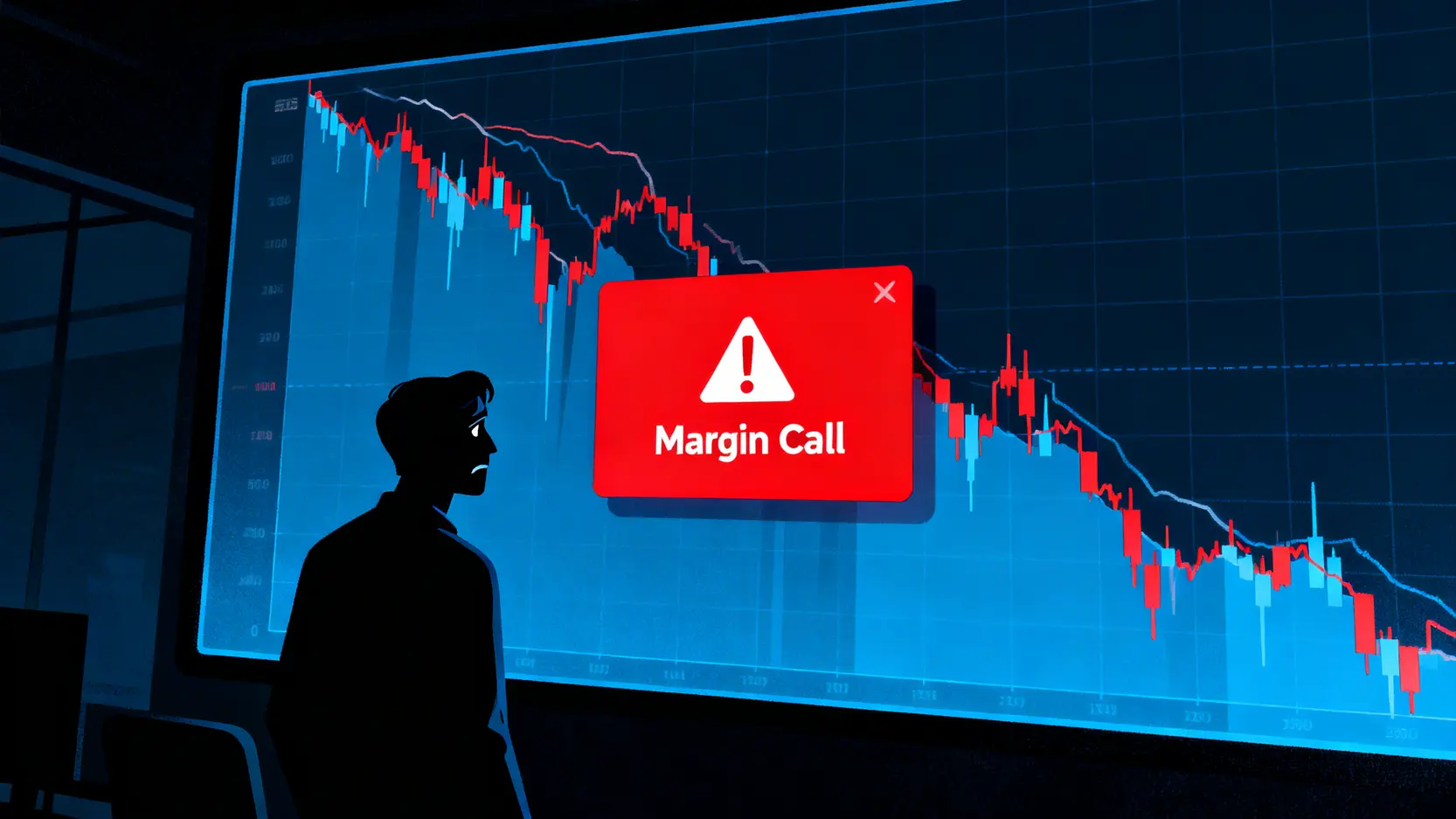
A margin call refers to a mechanism in which, when a leveraged position moves unfavorably and account equity becomes insufficient to meet margin requirements, the trading service provider requires the trader to add funds, provide eligible collateral, or reduce position size. It is common in stock margin accounts, futures, foreign exchange, contracts for difference (CFDs), short options positions, and other trading products with leverage or margin arrangements.
In leveraged trading, traders deposit only part of the total position value as initial margin, but profit and loss are usually calculated based on the full notional position. If the market price moves unfavorably, losses are deducted from account equity. When account equity falls below the maintenance margin, variation margin, or the risk threshold set by the platform, a margin call notice may be triggered.
Variation margin is the margin requirement that increases or decreases according to price changes in the position. Its function is to reflect real-time changes in unrealized losses or gains and align the account’s funding level with current market risk. In futures and certain cleared derivatives markets, variation margin is usually related to daily mark-to-market or intraday mark-to-market mechanisms; on retail leveraged trading platforms, traders more commonly see account equity, available margin, margin level, and forced liquidation ratio.
Core Terms Involved in Margin Calls
Initial margin: the minimum capital required when opening a position, usually expressed as a percentage of the position’s notional value, such as 5%, 10%, or 50%.
Maintenance margin: the minimum account equity level that must be maintained during the holding period; falling below this level may trigger an additional funding requirement or position close-out.
Variation margin: additional margin or returned margin generated according to price changes in the position, used to reflect changes in unrealized profit and loss.
Account equity: the net value of the account’s cash balance plus unrealized profit or loss, an important indicator for assessing margin adequacy.
Available margin: the remaining funds after account equity deducts used margin, which can be used to absorb further fluctuations or establish new positions.
Forced liquidation: the process by which the trading service provider closes part or all of a position when account risk indicators fall below the platform’s rule requirements.
How Margin Calls Are Formed
The logic behind a margin call is straightforward: profit and loss on leveraged positions are calculated based on the full position value, while the account’s deposited margin is only a portion of the required funds. If price movements cause losses to expand, account equity declines and margin coverage weakens, so the platform may require the trader to add funds.
Margin calls do not occur only when prices fall. For long positions, a decline in the underlying price reduces account equity; for short positions, a rise in the underlying price expands losses and may also trigger a margin call. In addition, dividend adjustments, overnight financing costs, stock borrowing costs, currency conversion, trading commissions, and taxes may also reduce available funds in the account.
Leveraged Long Stock Example
Assume a trader uses leverage to buy 8,000 shares at 220 pence per share. Since 220 pence equals £2.20, the notional value of the position is 8,000 × £2.20 = £17,600. If the trading service provider requires 5% initial margin, the opening margin is £17,600 × 5% = £880.
The opening price is 220 pence per share, and the position size is 8,000 shares.
The initial notional position is 8,000 × £2.20 = £17,600.
The initial margin requirement is 5%, and the required margin is £17,600 × 5% = £880.
The share price falls from 220 pence to 219 pence, producing a loss of 1 pence per share, or £0.01.
The position loss is 8,000 × £0.01 = £80.
The new position value is 8,000 × £2.19 = £17,520.
At 5%, the new margin requirement is £17,520 × 5% = £876.
If there are no additional funds in the account, the trader must cover both the £80 floating loss and the £876 margin requirement, creating total funding pressure of £956.
This example shows that after a price decline, the margin requirement corresponding to the notional position may decrease slightly, but the loss itself reduces account equity. Traders should not look only at the new margin requirement; they also need to calculate unrealized losses and remaining account funds. If account funds are insufficient, the platform may issue a margin call notice. If funds are not added within the required time, the platform may reduce the position size or close the position directly.
Triggers of Margin Calls
Margin calls are usually triggered by account risk indicators rather than by a single price level. Different platforms may use different terminology, but the core principle is to compare account equity with margin requirements.
Unfavorable price movement: a decline in a long position or a rise in a short position reduces account equity.
Excessive leverage: the lower the margin requirement, the more pronounced the impact of the same price movement on account equity.
Oversized position: the larger the notional position, the greater the profit or loss generated by each unit of price movement.
Rising financing costs: overnight financing costs, stock borrowing fees, and changes in funding rates may gradually erode account equity.
Short dividend adjustment: when shorting stocks or stock-index-related products, if the underlying constituents go ex-dividend, the account may need to bear the corresponding dividend adjustment.
Currency conversion impact: products denominated in a currency different from the account base currency may have profit, loss, and margin affected by exchange rate movements.
Market gaps: when prices skip multiple quote levels, account equity may decline rapidly in a short period.
Relationship Between Margin Calls and Forced Liquidation
A margin call notice is usually a preliminary step in risk handling, while forced liquidation is the execution step after risk further deteriorates. If the trader adds funds in time, reduces the position, or market prices recover, the account may again meet margin requirements. If account equity continues to decline, the platform may close part or all of the position according to its rules.
Under certain regulated retail CFD frameworks, regulations require account-level margin close-out protection and negative balance protection. Margin close-out protection is used to limit further loss expansion, while negative balance protection is used, for certain account types, to prevent retail clients from losing more than the funds in their account. However, the scope of these protections depends on jurisdiction, product type, and client classification, so traders should not assume that all accounts have the same protections.
What to Consider When Deciding Whether to Use Leverage
The risk of leveraged trading should not be measured only by the idea of “less initial capital required.” A more appropriate approach is to first calculate the full notional position, then estimate the impact of price fluctuations, financing costs, and extreme market scenarios on account equity. If traders open positions only based on whether the margin amount is sufficient, without assessing the possible losses generated by the full position, they may easily underestimate risk.
From an economic outcome perspective, excluding financing costs, spreads, commissions, and taxes, the monetary profit or loss generated by the same price change in the same asset quantity may be the same for both fully funded trading and leveraged trading. The difference is that leveraged trading uses less initial capital, so profit and loss volatility relative to the capital committed is larger, and margin shortfalls and forced liquidation are more likely to occur.
Leverage Risk Assessment Process
Confirm the product type, such as a stock margin account, futures, foreign exchange, CFD, options, or other derivatives.
Calculate the notional position, such as number of shares × share price, or number of contracts × contract multiplier × underlying price.
Confirm the initial margin requirement, such as 5%, 10%, 20%, or 50%.
Calculate the profit or loss corresponding to each unit of price movement, such as each 1 pence, each 1 point, or each 0.0001 exchange-rate point.
Estimate the adverse movement range, such as the impact of a 1%, 3%, 5%, or 10% price change on account equity.
Check maintenance margin, margin call, and forced liquidation rules.
Calculate financing costs, spreads, commissions, dividend adjustments, stock borrowing costs, and other fees.
Confirm whether negative balance protection exists and whether it applies to the current account and product.
Leverage can reduce the capital required to open a position, but it does not reduce the price volatility of the underlying asset. Traders need to view leverage as a risk exposure tool rather than a promise of amplified returns. The focus of risk management lies in the relationship among notional position, account equity, and market volatility.
Common Leveraged Trading Products
Leveraged trading is usually implemented through derivatives or margin accounts. A derivative is a financial instrument whose value is derived from an underlying asset, index, interest rate, exchange rate, or other reference indicator. Through derivatives, traders do not necessarily directly own the underlying asset; instead, they establish an economic relationship with changes in the price of the underlying asset.
| Item Name | Key Parameters | Applicable Scenarios | Main Risks |
|---|---|---|---|
| CFDs | Margin requirement, spread, overnight financing cost, forced liquidation ratio | Used to obtain contractual exposure to price changes in stocks, indices, foreign exchange, or commodities | No ownership of the underlying asset; leverage amplifies losses; some accounts may involve platform counterparty risk |
| Margin Forex Trading | Currency pair quotes, lot size, pip value, leverage ratio, overnight interest | Used to trade price changes of one currency relative to another | Exchange rate fluctuations, interest rate differentials, liquidity changes, and high leverage may lead to rapid losses |
| Futures Contracts | Contract multiplier, expiration month, initial margin, maintenance margin, daily settlement | Used to manage or trade future price risk in indices, commodities, interest rates, and foreign exchange | Daily mark-to-market may create variation margin requirements; contract expiration and rollover need separate management |
| Options Contracts | Strike price, expiration date, premium, implied volatility, margin requirement | Used to build nonlinear risk-return structures or manage price volatility risk | Buyers may lose the premium; sellers may face higher margin requirements and nonlinear loss exposure |
Spread Betting, CFDs, and Forex Trading
Financial spread betting is mainly seen in markets such as the United Kingdom. Traders do not directly buy or sell the underlying asset; instead, outcomes are calculated according to the amount assigned to each unit of price movement. Such products usually have leverage characteristics and may involve spreads, financing costs, and margin requirements.
A CFD is a contract in which the two parties exchange the price difference of the underlying asset between opening and closing the position. It can cover underlying assets such as stocks, indices, commodities, foreign exchange, and bonds. CFD traders usually do not own the underlying asset, so they do not have the same shareholder rights as direct stockholders, but they may be subject to dividend adjustments, financing costs, and price fluctuation risk.
Margin forex trading is leveraged trading based on currency pairs. Examples include EUR/USD, GBP/USD, and USD/JPY. Its key parameters include trade lot size, pip value, quotation precision, leverage ratio, overnight interest, and liquidity conditions. Because the notional amount of currency pairs is large, even small exchange rate movements may cause noticeable changes in account equity.
Futures, Options, and Binary Options
A futures contract is a standardized contract that agrees to buy or sell an underlying asset at a future time according to specific rules. Futures are usually traded on exchanges and have contract multipliers, expiration months, daily settlement, initial margin, and maintenance margin. Daily settlement reflects the day’s profit or loss in the account, so adverse price movements may create variation margin requirements.
An option is a contract that gives the buyer the right, but not the obligation, to buy or sell an underlying asset at an agreed price on or before a specific date. The option buyer pays a premium, and the maximum loss is usually limited to the premium paid. The option seller receives the premium but may face higher margin requirements and more complex risk exposure.
Binary options are a type of product whose outcome is usually structured as a fixed payout or zero payout, often designed around a “yes/no” judgment. Because of their complex product structure and high risk of loss for retail clients, European and U.K. regulatory frameworks have banned or strictly restricted the sale of binary options to retail clients. When discussing this product, the focus should be on regulatory restrictions, risk disclosures, and suitability requirements, rather than treating it as an ordinary trading instrument.
Risk Control Points for Margin Calls
A margin call is not a standalone fee; it is an additional funding requirement when account risk is insufficiently covered. It reminds traders that capital usage in margin trading is only an initial condition, while subsequent price changes, costs, and rule changes may all change the required account funding.
Avoid opening positions based only on initial margin; assess potential losses based on the full notional position.
Keeping an additional cash buffer in the account may reduce the probability that small price fluctuations trigger a margin call.
Pay attention to maintenance margin ratios, forced liquidation thresholds, and the platform’s notification methods.
Understand that short positions may involve stock borrowing fees, dividend adjustments, and theoretically unlimited upside risk in the underlying price.
Before holding positions overnight, check financing costs and settlement times to avoid underestimating long-term holding costs.
Check margin usage before high-volatility events, such as earnings releases, central bank meetings, inflation data, and contract expiration dates.
Negative balance protection, leverage limits, and product restrictions differ across jurisdictions and should be based on the rules where the account is held.
In an educational trading context, a margin call should be understood as a risk calibration mechanism for leveraged accounts. It is neither a profit opportunity nor merely a platform fee item, but a funding or position adjustment requirement triggered when account equity can no longer cover position risk.
Questions Related to Margin Calls
What is the difference between a margin call and initial margin?
Initial margin is the capital required when opening a position, while a margin call is an additional funding requirement that arises when account equity becomes insufficient during the holding period. The former is used to establish the position, while the latter is used to maintain the position after price changes.
What does variation margin mean?
Variation margin is the margin requirement adjusted according to price changes in a position. If the position incurs losses, the account may need additional funds; if the position gains, account equity may increase. Products such as futures often reflect variation margin through daily mark-to-market.
Why might additional funds still be required after margin requirements decrease?
Margin requirements may decrease slightly as position value declines, but position losses directly reduce account equity. If the loss amount is greater than the remaining cash buffer in the account, the trader may still need to add funds to meet the new margin requirement and cover the loss.
What happens if a margin call is not met?
If the trader does not add funds or reduce the position within the specified time, the trading service provider may close part or all of the position according to platform rules. The forced liquidation price is affected by market liquidity and slippage and may not equal the trader’s expected price.
Why can short positions also trigger margin calls?
A short position incurs losses when the underlying price rises, which reduces account equity. In addition, short stocks or stock-index-related products may involve dividend adjustments, stock borrowing costs, and financing charges, all of which may increase margin pressure.
What are the main types of leveraged products?
Common leveraged products include CFDs, margin forex trading, futures, options, and certain stock margin accounts. Different products have different margin requirements, settlement methods, cost structures, and regulatory protections, so one set of risk assumptions cannot be applied to all products.