Learn how pending orders work in forex trading, including Buy Limit, Sell Limit, Buy Stop, Sell Stop, MT5 stop limit orders, execution logic, slippage, market gaps and risk control.
The Origin and Evolution of Pending Orders
From Exchange Limit Order Books to Electronic Trading Platforms
The concept of pending orders did not originate in the era of electronic trading. As early as the 19th century, securities exchanges had already introduced order forms similar to limit orders. Under the traditional trading system of the New York Stock Exchange (NYSE), a specialist was responsible for maintaining a handwritten Limit Order Book, which recorded all pending orders submitted by investors with specified prices and directions. When the market price reached the specified price of a limit order, the specialist was responsible for executing that order.
In 1867, Edward A. Calahan invented the stock ticker, one of the earliest electronic devices for transmitting financial market information. The appearance of the ticker allowed off-floor brokers to obtain real-time price information, making it easier to manage limit orders and stop orders. From the late 19th century to the mid-20th century, limit orders and stop orders gradually became standard order types in securities markets.
After the 1990s, as electronic trading platforms became widely adopted, order types became more diversified. TheMT4platform, released in 2005, supported four types of pending orders, while theMT5platform, released in 2010, added two composite pending order types: Buy Stop Limit and Sell Stop Limit. These additions gave retail traders more refined control over order execution.
The Development of Pending Order Systems in MT4 and MT5
Since its launch in 2005, the MT4 platform has remained one of the mainstream platforms for retail forex trading. It supports four types of pending orders: Buy Limit, Sell Limit, Buy Stop and Sell Stop. These four types cover most trading scenarios, including buying on pullbacks, selling on rebounds, buying breakouts and selling breakdowns.
The MT5 platform was released in 2010. While retaining all four basic pending order types available in MT4, it added two composite pending orders: Buy Stop Limit and Sell Stop Limit. The design logic behind these two composite orders comes from the “breakout followed by pullback entry” strategy commonly used in professional trading. By combining the functions of a stop order and a limit order into a single instruction, they reduce the number of manual steps required from traders.
Mechanism of the Four Basic Pending Orders
Limit Pending Orders: Buy Limit and Sell Limit
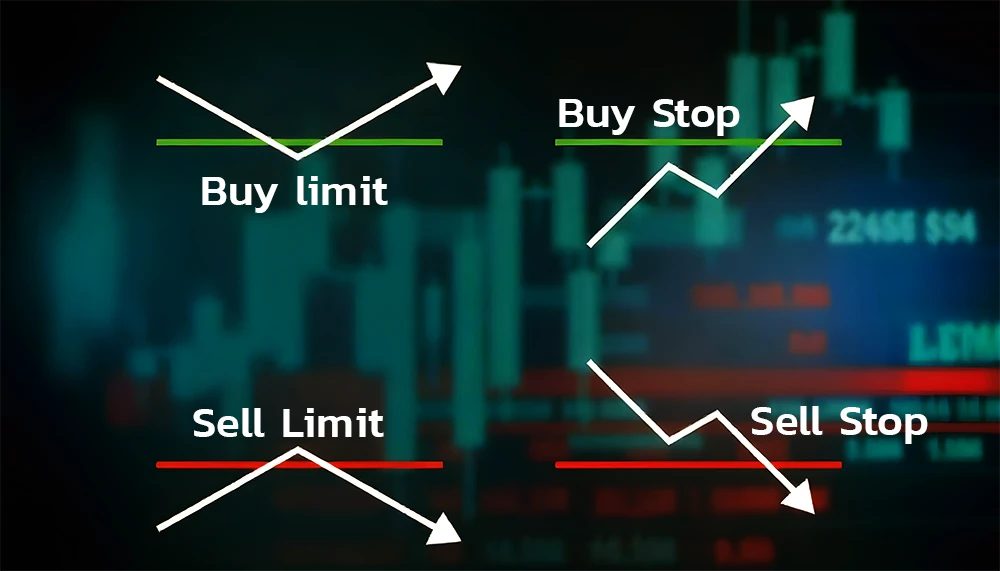
Buy Limit and Sell Limit are collectively known as limit orders. Their core feature is that the execution price will not be worse than the preset price. In other words, the actual execution price of a Buy Limit will not be higher than the preset price, while the actual execution price of a Sell Limit will not be lower than the preset price.
A Buy Limit is placed below the current Ask price. The logic is that the trader believes the current price is relatively high and expects the market to pull back to a certain support level before rebounding. The trader therefore places a buy order in advance at that level and waits for execution. When the Ask price falls to the preset level, the system executes the buy order at the preset price or a better price.
A Sell Limit is placed above the current Bid price. The logic is that the trader believes the current price is relatively low and expects the market to rebound to a certain resistance level before falling back. The trader therefore places a sell order in advance at that level and waits for execution. When the Bid price rises to the preset level, the system executes the sell order at the preset price or a better price.
Stop Pending Orders: Buy Stop and Sell Stop
Buy Stop and Sell Stop are collectively known as stop orders. It should be noted that in the context of forex pending orders, “stop” does not refer to limiting losses. Instead, it refers to using a stop-trigger mechanism as the method for activating the order. The key difference between stop orders and limit orders is that once a stop order is triggered, it is converted into an executable order, meaning the final execution price may be affected by slippage.
A Buy Stop is placed above the current Ask price. The logic is that the trader expects the price to break above a key resistance level and continue rising after the breakout. When the Ask price rises to the preset level, the system executes a buy order at market price. Because stop orders are executed at market price, the actual execution price may be higher than the preset trigger price during fast-moving breakout conditions.
A Sell Stop is placed below the current Bid price. The logic is that the trader expects the price to break below a key support level and continue falling after the breakdown. When the Bid price falls to the preset level, the system executes a sell order at market price. During a rapid market decline, the actual execution price may be lower than the preset trigger price.
| Pending Order Type | Placement Level | Execution Method After Trigger | Corresponding Market Expectation |
|---|---|---|---|
| Buy Limit | Below the Ask price | Limit execution with no adverse slippage | Price rebounds after a pullback |
| Sell Limit | Above the Bid price | Limit execution with no adverse slippage | Price falls after a rebound |
| Buy Stop | Above the Ask price | Market execution with possible slippage | Price continues rising after breaking resistance |
| Sell Stop | Below the Bid price | Market execution with possible slippage | Price continues falling after breaking support |
How MT5 Composite Pending Orders Work
The Two-Step Trigger Logic of Buy Stop Limit
Buy Stop Limit is a composite pending order type unique to MT5. It combines the functions of a Buy Stop order and a Buy Limit order into a single instruction. This order requires two price parameters:
Stop Price: set above the current Ask price
Limit Price: set below the Stop Price
The execution process is divided into two stages. In the first stage, when the Ask price rises to the Stop Price, the system automatically places a Buy Limit order at the Limit Price. In the second stage, if the price then pulls back from the Stop Price to the Limit Price or lower, the Buy Limit order is executed.
This two-step mechanism is designed to meet the trading need of “entering on a pullback after breakout confirmation.” Traders want to obtain a trend confirmation signal when price breaks above resistance, but they do not want to chase the breakout at a high level. Instead, they wait for the price to pull back to a more reasonable level before executing the buy order.
The Two-Step Trigger Logic of Sell Stop Limit
The working logic of a Sell Stop Limit is symmetrical to that of a Buy Stop Limit. It also requires two price parameters:
Stop Price: set below the current Bid price
Limit Price: set above the Stop Price
In the first stage, when the Bid price falls to the Stop Price, the system automatically places a Sell Limit order at the Limit Price. In the second stage, if the price then rebounds from the Stop Price to the Limit Price or higher, the Sell Limit order is executed.
This mechanism is suitable for the scenario of “selling on a rebound after breakdown confirmation.” Traders want to confirm the downtrend when price breaks below support, but they wait for a brief rebound to a higher level before executing the sell order in order to obtain a more favorable execution price.
| Comparison Item | MT4 Platform | MT5 Platform | Difference |
|---|---|---|---|
| Basic pending order types | 4 types: Buy Limit, Sell Limit, Buy Stop, Sell Stop | 4 types: same as MT4 | The basic pending order types are identical |
| Composite pending order types | Not supported | 2 types: Buy Stop Limit and Sell Stop Limit | Composite order types added in MT5 |
| Pending order validity period | Valid for the day or manually canceled | Supports multiple validity period settings | MT5 provides more flexible expiration options |
| Order management method | Managed through the Terminal window | Managed through the Toolbox | The operating interface differs |
The Role of Pending Orders in Market Microstructure
The Essential Execution-Level Difference Between Limit Orders and Stop Orders
From a market microstructure perspective, limit orders and stop orders play very different roles in market liquidity. Before being triggered, a limit order rests in the broker’s order book and provides liquidity to the market. It is essentially a commitment to other market participants: “I am willing to trade at this price.” A stop order, by contrast, is not visible to the market before it is triggered. Once triggered, it is executed at market price and therefore consumes market liquidity.
In actual trading, this difference means that limit orders can usually be executed at the preset price or a better price under normal market conditions, because the limit price controls the maximum or minimum acceptable execution price. Stop orders, however, are executed at market price once triggered. When market liquidity is insufficient or prices move sharply, the actual execution price may deviate significantly from the trigger price, resulting in slippage.
The Impact of Gaps and Slippage on Pending Order Execution
During weekend market closures, forex prices may gap sharply due to major economic events or political developments. When the market opens on Monday, the price may jump directly beyond the trigger price preset by the trader. In this situation:
Limit pending orders: Buy Limit and Sell Limit are executed at the preset price or a better price. For example, if a Buy Limit is set at 1.1000 and the Monday opening price is 1.0950, the order will be executed at 1.0950, which is more favorable than the preset price
Stop pending orders: Buy Stop and Sell Stop are executed at market price. The execution price may be the first available price after the market opens and may differ substantially from the trigger price. For example, if a Sell Stop is set at 1.0950 and the Monday opening price is 1.0900, the order may be filled at 1.0900 or lower, resulting in slippage of 50 pips or more
It was never my thinking that made the big money for me. It was always my sitting.
Common Questions About Pending Orders
What are the key differences between MT4 and MT5 in pending order functions?
The most significant difference lies in support for composite pending orders. MT4 supports only four basic pending orders: Buy Limit, Sell Limit, Buy Stop and Sell Stop. MT5 adds two composite pending orders on top of these: Buy Stop Limit and Sell Stop Limit. In addition, MT5 provides more options for setting the validity period of pending orders, such as validity until a specified date, while pending orders in MT4 are usually valid for the day or remain active until manually canceled. The basic pending order types and trigger mechanisms of the two platforms are otherwise identical.
What is the essential difference between a Stop Limit order and a pure Stop Order?
The core difference is the execution method after the order is triggered. A pure stop order, such as a Buy Stop, is executed as a market order once the price reaches the trigger price. The execution price may deviate from the trigger price due to slippage. A Stop Limit order, such as a Buy Stop Limit, places a limit order after the price reaches the trigger price. The execution price is constrained by the preset limit price, so there will be no adverse slippage beyond the limit price. The trade-off is that the second step of the Stop Limit order, namely the limit order portion, may not be executed if the expected pullback does not occur. A pure stop order, by contrast, will be executed once triggered.
How are pending orders executed when the market opens with a gap?
It depends on the type of pending order. Limit pending orders, including Buy Limit and Sell Limit, are executed after a gap at a price that is favorable or equivalent for the trader, because the limit mechanism ensures that the execution price is not worse than the preset level. For example, if a Buy Limit is set at 1.1000 and the market gaps open at 1.0950, the order will be executed at 1.0950. Stop pending orders, including Buy Stop and Sell Stop, are executed at market price after a gap. The execution price may be the opening price after the gap, and there may be a large difference between that price and the trigger price. This price difference is known as gap slippage and is one of the risks that requires particular attention in forex trading.
Why can limit orders avoid slippage while stop orders cannot?
This is related to their execution mechanisms. A limit order is subject to a price restriction when executed: a Buy Limit will only be filled at the preset price or lower, while a Sell Limit will only be filled at the preset price or higher. This mechanism ensures that the execution price will not be unfavorable to the trader. A stop order is converted into a market order after it is triggered, meaning the system executes it at the best available price in the market at that moment. That price may deviate from the trigger price due to insufficient liquidity or sharp price movements. In short, a limit order controls “at what price the trade is executed,” while a stop order only controls “when the order is triggered” and does not control the final execution price.