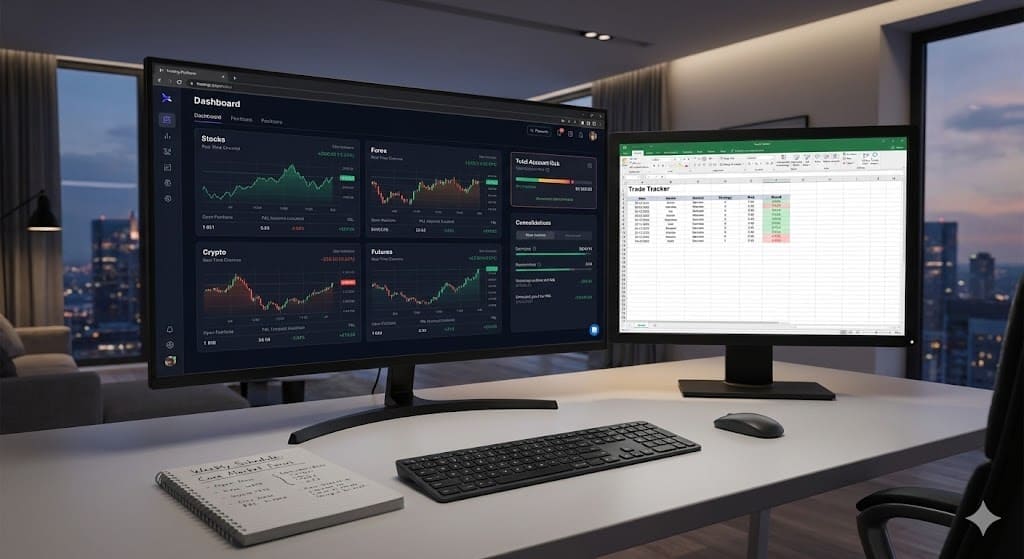
This guide explains how to build a trading plan, covering trading signals, motivation, time commitment, SMART objectives, risk tolerance, capital allocation, market selection, trading journals, and regular review methods.
Logic for Creating a Trading Plan
A trading plan is a personalized decision-making framework prepared by a trader before placing live orders. It explains why the trader trades, how much time to allocate, how much capital to use, which markets to choose, how much risk to take, and how to record and review trading activity. It is not a fixed template, nor is it a prediction of future prices. Rather, it is a document that helps traders transform trading behavior from spontaneous reactions into rule-based execution.
When creating a trading plan, personal conditions need to be written into the plan. Traders differ in capital size, available time, risk tolerance, product experience, and psychological state, so there is no “perfect plan” that applies to everyone. An effective trading plan should explain how the trader acts under specific market conditions, and also explain why no action is taken when conditions are not met.
A trading plan should usually cover seven areas: motivation, time commitment, trading objectives, risk attitude, trading capital, trading markets, and record keeping. Each item should use measurable parameters as much as possible, such as trading time of 30 minutes to 2 hours per day, risk per trade not exceeding 1% of account equity, one review per week, and statistical summaries every 20 trades. Quantified expressions help reduce room for interpretation.
A Trading Plan Is Not a Trading Signal
A trading signal only answers whether opening or closing conditions are met at a specific moment. A trading plan answers broader questions, including account risk boundaries, trading instrument restrictions, execution discipline, trading suspension conditions, and review methods. Trading signals can be included in the plan, but they cannot replace the plan.
Trading signals focus on specific market conditions, such as price breakouts, moving average crossovers, volatility changes, or increased trading volume.
A trading plan focuses on the overall execution framework, such as whether trading is allowed, how large the position should be, and how losses should be handled.
A trading journal focuses on actual execution results, such as whether orders were placed according to the plan, what the costs were, and whether emotions affected judgment.
Risk rules focus on account protection, such as risk per trade, maximum drawdown, margin usage, and leverage limits.
Define Trading Motivation
Trading motivation is the starting point for creating a trading plan. It explains why the trader participates in the market, such as learning how financial markets work, validating a type of strategy, managing portfolio risk, or engaging in active trading within a tolerable risk range. The more specific the motivation is, the easier it is to judge whether later objectives are reasonable.
If the trading motivation is mainly to seek excitement, the plan should specifically include limits on trading frequency, maximum loss limits, and cooling-off rules, because high-frequency impulsive behavior can easily lead to overtrading. If the trading motivation is to learn market mechanisms, the trader may first use a demo account or small positions, setting the main objective as execution training and complete record keeping rather than short-term results.
The Role of Recording Motivation
Helps distinguish learning objectives, asset allocation objectives, and short-term trading objectives.
Helps identify whether emotional drivers exist, such as the urge to recover losses or seek excitement.
Helps set trading frequency, such as 0 to 3 trades per day, 0 to 10 trades per week, or observation only during specific event windows.
Helps determine product scope, such as first studying stocks and ETFs rather than trading foreign exchange, futures, and options at the same time.
Helps define suspension conditions, such as stopping trading and reviewing after 3 consecutive unplanned trades.
Assess Time Commitment
Time commitment determines whether a trading plan can be executed. Intraday trading, swing trading, and medium- to long-term investing require different amounts of time. Intraday trading usually requires continuous monitoring of quotes, order books, volume, and news events. Swing trading may require review once or twice a day. Medium- to long-term allocation places more emphasis on fundamentals, valuation, and portfolio rebalancing.
A trading plan should clearly state available time rather than assuming that the trader can watch the market at any moment. For example, if a trader can only spend 45 minutes after the market close each day, it is not suitable to create an intraday strategy that requires real-time monitoring. If only 2 to 3 hours per week are available for research, the plan should lean more toward low-frequency trading or index-related instruments.
Matching Time Commitment With Trading Horizon
| Item Name | Key Parameters | Applicable Scenarios | Main Risks |
|---|---|---|---|
| Intraday Trading Plan | Daily observation of 2 to 6 hours; holding period from several minutes to 1 trading day | Suitable for traders who can monitor quotes, orders, and risk exposure in real time | High trading frequency, with spreads, slippage, commissions, and emotional fluctuation having greater impact |
| Swing Trading Plan | Daily review of 30 to 90 minutes; holding period of 1 to 20 trading days | Suitable for traders who cannot watch the market all day but can regularly check markets and orders | Overnight gaps, event risk, and stop-loss execution deviation may affect results |
| Medium- to Long-Term Plan | Weekly research of 2 to 5 hours; holding period of several months or longer | Suitable for traders focused on fundamentals, valuation, asset allocation, and portfolio rebalancing | Drawdown periods may be long, and macro changes or industry cycles may alter original assumptions |
| Demo Training Plan | Review 1 to 2 times per week; starting sample size of 20 to 50 trades | Suitable for beginners learning order types, market volatility, and trading journal records | Demo environments lack real capital pressure, so execution discipline may differ from live trading |
Set SMART Trading Objectives
Trading objectives need to be checkable and measurable rather than vague wishes. The SMART objective framework can be used to improve objective quality. SMART usually refers to Specific, Measurable, Achievable, Relevant, and Time-bound. An early version of this framework was proposed by George T. Doran in 1981 and is commonly used in goal management and project management. In a trading plan, SMART objectives can help traders convert vague ideas into assessable indicators.
For example, “I want to become rich quickly” is not an effective trading objective because it does not include a specific amount, time range, risk limit, or execution path. “Over the next 12 months, complete at least 50 trades that comply with the plan and conduct monthly reviews, while keeping risk per trade below 1% of account equity and maximum drawdown below 10%” is closer to an executable objective. If the objective involves portfolio value growth, risk constraints and an evaluation period should also be stated.
Steps for Creating SMART Objectives
Specific: state the target object, such as trading journal completion rate, strategy execution rate, maximum drawdown, or number of trade samples.
Measurable: provide numerical standards, such as reviewing once per week, recording 50 consecutive trades, or keeping the proportion of unplanned trades below 10%.
Achievable: set objectives based on account size, time commitment, and experience level, without using unrealistic return assumptions.
Relevant: objectives should serve the trading plan, such as improving execution discipline, reducing costs, or validating a strategy, rather than being unrelated to trading.
Time-bound: set an evaluation period, such as 4 weeks, 3 months, 6 months, or 12 months.
In the example question, “I want to increase my portfolio value by 10% over the next 12 months” is more consistent with a SMART objective than “I want to get rich quickly,” because the former at least includes a time range and a measurable result. However, for a rigorous trading plan, it should also include risk constraints, such as maximum drawdown, risk per trade, permitted product range, and evaluation benchmark.
Assess Risk Tolerance
Risk tolerance refers to a trader’s ability and willingness to bear losses both psychologically and financially. Market prices may fluctuate because of interest rates, exchange rates, corporate earnings, policy changes, liquidity, and unexpected events. Even highly liquid financial instruments may experience significant price movements during specific periods.
Risk tolerance is closely related to trading objectives. A trading plan that seeks higher volatility exposure usually requires stricter position control and a larger cash buffer. A more conservative plan may place greater emphasis on capital preservation, lower leverage, and a longer evaluation period. It should be noted that higher target returns usually come with higher volatility and possible drawdowns, and target returns should not be written as return promises.
How Risk Parameters Should Be Written Into the Plan
Risk per trade: for example, maximum loss per trade should not exceed 0.5% to 2% of account equity.
Daily risk: intraday traders may set a maximum daily loss of 2% to 5% of account equity, after which trading stops.
Maximum drawdown: for example, when the account declines 5%, 10%, or 15% from a recent high, new trades are paused and reviewed.
Leverage cap: for example, no leverage for ordinary stocks, and leverage for index or forex products limited to 1:2 to 1:10.
Correlation limits: avoid holding highly correlated instruments at the same time, which may concentrate exposure to the same risk factor.
Event restrictions: before major earnings releases, central bank decisions, or high-impact data releases, reduce position size or avoid opening new positions.
The function of risk parameters is to limit the impact of single mistakes and repeated mistakes on the account. They are not fixed standards or profit guarantees, but tools that help traders define a tolerable range in advance.
Determine Trading Capital
Trading capital is the money that a trader plans to use for market trading. This capital should be separated from daily living expenses, emergency funds, and necessary long-term funds. A trading plan should clearly state the size of trading capital, maximum tolerable loss, rules for adding funds, and conditions for stopping trading.
In leveraged products, trading capital cannot be understood only by the margin amount. Contracts for difference (CFDs), margin foreign exchange, futures, and options may allow traders to control a larger notional position with less capital, so full risk exposure should be calculated. If a trader cannot currently tolerate potential losses, a demo account can first be used to practise order placement, record keeping, and review.
Trading Capital Checklist
Confirm independent funds available for trading, without using living expenses, emergency funds, or short-term necessary funds.
Set maximum capital risk, such as a maximum acceptable loss of 10% to 20% of total trading capital.
Calculate risk amount per trade; for example, if account equity is $10,000, 1% risk per trade equals $100.
Confirm the product’s notional value and avoid focusing only on margin while ignoring the full position.
Reserve for trading costs, including spreads, commissions, slippage, financing costs, and taxes.
Set stop conditions, such as pausing trading after 5 consecutive losses or an 8% monthly drawdown.
Select Trading Markets
Trading market selection should be based on level of understanding, trading hours, volatility characteristics, liquidity, and cost structure. Stocks, foreign exchange, commodities, indices, futures, options, and ETFs operate differently, so markets should not be selected only based on the magnitude of price fluctuations.
If a trader has long followed technology companies, the retail sector, or the energy sector, researching related stocks or sector ETFs may make it easier to build knowledge. If a trader focuses on macroeconomics, interest rates, and monetary policy, foreign exchange, Treasury futures, or stock index futures may better fit the research path. However, margin requirements, trading hours, and risk events vary significantly across markets and need to be written separately into the plan.
Key Dimensions for Market Screening
Trading hours: confirm market open, market close, pre-market and after-hours arrangements, and holiday schedules.
Volatility: measure average daily movement, average true range (ATR), or historical volatility.
Contract size: confirm the profit or loss corresponding to each 1 point, 1 pence, 1 dollar, or 0.0001 exchange-rate point movement.
Liquidity: observe trading volume, bid-ask spread, order book depth, and quote stability during extreme periods.
Trading costs: estimate spreads, commissions, financing costs, exchange fees, and taxes.
Information sources: confirm whether stable access is available to earnings reports, economic data, announcements, volume, and historical price data.
After selecting markets, traders should maintain research focus for a period of time. For example, they can first observe 1 to 3 markets, continuously record at least 20 to 50 demo or small-size trade samples, and then judge whether the strategy and execution process need adjustment. Frequently switching markets weakens the consistency of review samples.
Establish a Trading Journal and Record-Keeping Mechanism
For a trading plan to be useful, it must be supported by a trading journal. A trading journal is a written record of the entire trading process, used to measure whether the plan was executed, whether the strategy matched expectations, whether costs were controllable, and whether emotions affected decisions. Without a journal, traders may easily remember only profit or loss results while overlooking execution deviations.
What a Trading Journal Should Record
Record the trade date, trading instrument, direction, quantity, entry price, and exit price.
Record the trade rationale and identify which rule in the plan the trade corresponds to.
Record expected return and maximum risk, but avoid presenting expected return as a certain outcome.
Record the order type, such as market order, limit order, stop order, or stop-limit order.
Record trading costs, including spreads, commissions, slippage, and overnight financing costs.
Record emotional state before, during, and after the trade.
Record whether the trade deviated from the plan and why.
Record review conclusions, such as whether rules were clear, execution was consistent, and whether the plan needs modification.
A trading journal can also be used to calculate long-term statistics. Examples include win rate, average profit, average loss, reward-to-risk ratio, maximum drawdown, number of consecutive losses, and proportion of unplanned trades. It should be noted that a single trade result cannot determine whether a strategy is good or poor, and when the sample size is small, excessive conclusions should not be drawn.
Reviewing and Revising a Trading Plan
A trading plan does not remain unchanged forever after it is written. Market structure, personal time availability, account size, and trading experience may all change, so regular review and revision are necessary. Plan revisions should be based on trading journals and statistical data rather than a single emotional reaction.
Metrics to Check During Review
Plan execution rate: the proportion of trades that comply with the plan among total trades.
Proportion of unplanned trades: whether trades not executed according to the plan exceed a preset threshold, such as 10% or 20%.
Cost ratio: the proportion of spreads, commissions, slippage, and financing costs in total profit and loss.
Risk deviation: whether actual loss per trade exceeded the planned limit.
Market fit: whether the trading hours, volatility, and costs of the selected market fit personal conditions.
Emotional deviation: whether early exits, chasing price, increasing position size, or continuous trading occur frequently.
If review shows that the main reason for deviation is unclear rules, the rule wording should be revised. If the main reason is insufficient execution discipline, trading frequency should be reduced, position size lowered, or a cooling-off period added. If the main reason is a change in market conditions, the applicable environment of the strategy should be reassessed. The goal of revising the plan is to improve the executability of rules, not to react to every price movement.
Questions Related to Creating a Trading Plan
How long does a trading plan need to be to be complete?
The completeness of a trading plan is not determined by word count, but by whether it covers objectives, markets, risk, position sizing, execution, and review. A short plan with clear parameters is usually more practical than a lengthy plan that lacks executable rules.
Are SMART objectives suitable for writing return targets?
Return targets can be written, but risk constraints and evaluation periods should be included at the same time. For example, simply writing “10% growth over 12 months” is still incomplete; maximum drawdown, risk per trade, tradable instruments, and review frequency should also be stated.
How should trading capital be separated from living funds?
Trading capital should be independent from living expenses, emergency funds, and necessary short-term spending. The plan should state the maximum tolerable loss percentage and avoid using funds that cannot tolerate losses to participate in high-volatility or leveraged products.
Why should volatility be considered when selecting a trading market?
Volatility determines the typical price movement range within a given period and also affects position size, stop distance, and account equity fluctuation. If market volatility exceeds the trader’s tolerance range, even a correct directional judgment may be difficult to execute because of excessive interim fluctuation.
Why should a trading journal record emotional state?
Emotional state affects whether a trader exits early, chases price, increases position size, or deviates from the plan. Recording emotions can help traders identify behavioral patterns and judge whether problems come from strategy rules or execution discipline.
How often is it appropriate to revise a trading plan?
A plan can be revised by fixed cycle or sample size, such as monthly, quarterly, every 20 trades, or every 50 trades. Revisions should be based on data and records, and the plan should not be changed immediately because of a single profit or loss.