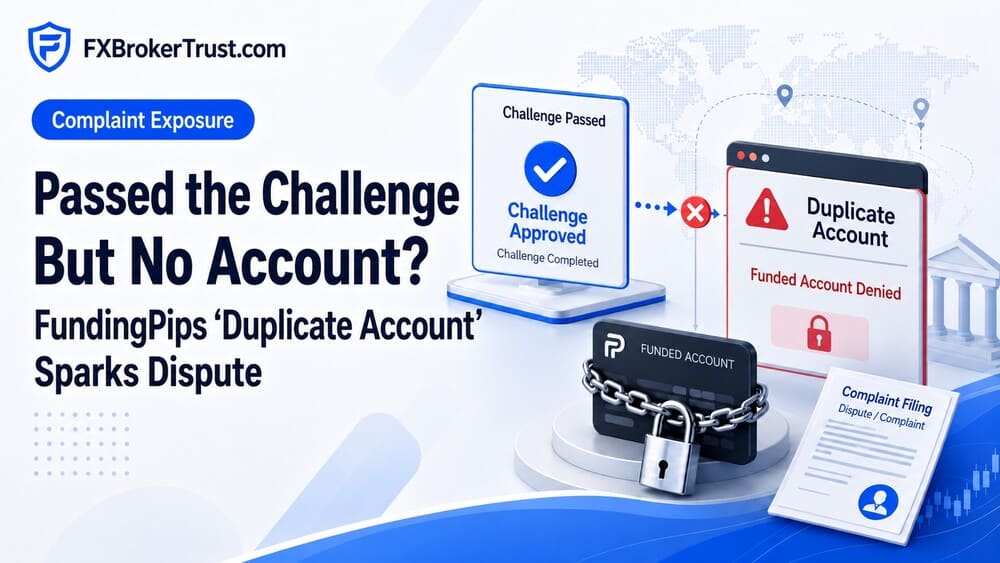
A trader says FundingPips refused a funded account after a two-step challenge, raising questions over duplicate account checks, KYC timing and fee transparency.
FundingPips refusal to issue account after challenge pass draws attention
In July 2026, a trader complained that after purchasing a challenge account on the proprietary trading platform FundingPips and completing two rounds of evaluation, the platform refused to issue a funded account at the funding stage on the grounds of a . According to the complaint materials, the trader said that during the purchase of the challenge package, completion of the first evaluation phase, completion of the second evaluation phase and subsequent trading process, they did not receive any clear notice from the platform about account abnormalities or ineligible participation status.
The trader stated that the dispute was not limited to a single account review result, but centred on the sequence between platform fees, eligibility review and post-challenge handling. According to the trader, the platform normally collected fees during the challenge purchase and evaluation process, and the relevant account was able to continue participating in the evaluation. However, after the trader completed the evaluation and reached the point of redeeming funded eligibility, the platform raised the duplicate account issue and did not arrange a refund for previous purchases.
At present, the relevant claims still mainly come from trader complaint materials. Whether the platform had provided prior notice of account issues in its user agreement, backend notifications, email records or risk control logs still needs to be further verified against full account records, payment evidence, KYC review emails and platform responses.
(Source: investor complaint materials, time: July 2026, position: two-phase evaluation, duplicate account determination, funded account issuance dispute.)
The dispute centres on eligibility determination after passing the challenge
According to the complaint materials, the trader believes that if account eligibility already had issues at the registration stage, the platform should have blocked the user when the challenge account was purchased or at an early stage of the evaluation, rather than refusing the account only after the evaluation had been completed. The key questions raised concern the timing of eligibility review, the handling of fees and whether the duplicate account standard was sufficiently clear.
If the account was not eligible for participation, why did the platform allow the user to purchase the challenge package?
If the account had a duplicate account issue, why did the platform allow it to continue paying for and entering evaluations?
If there were trading violations or account abnormalities during the trading process, why did the platform not issue a clear warning during the evaluation?
If the platform ultimately determined that the account was invalid, why did the relevant judgement appear only at the key stage after passing the challenge?
If the account did not meet the requirements from the beginning, why was there no simultaneous handling or refund explanation for previous challenge fees?
Public rules show that KYC is a prerequisite before account issuance
On itsGet Startedpage, the FundingPips Help Center states that after traders complete the evaluation, they will receive an identity verification email and need to submit a government-issued photo ID, proof of address dated within the last three months and a selfie. The page also shows that ifKYCis rejected due to a duplicate account, users cannot resubmit using a new email address and must use the account that has already completed verification.
On its2 Step Standardpage, FundingPips describes the two-phase evaluation as an industry-standard model. The page shows that the profit target for Phase 1 is 8% or 10%, the profit target for Phase 2 is 5%, and both phases require at least three trading days. The page also lists account sizes of USD 5,000, USD 10,000, USD 25,000, USD 50,000 and USD 100,000, while some countries or regions also have a USD 2,500 account size.
These public rules show that FundingPips includes identity verification, account review and trading rules in the funded account issuance process. However, judging from the complaint dispute, the issue is not only whether the platform has duplicate account restrictions, but whether the platform maintains the same clear, predictable and reviewable enforcement standard before charging fees, during evaluation and after the challenge has been passed.
(Sources: FundingPips Help Center,Get Started,2 Step Standard, retrieved: 2026-07-07, position: KYC Verification, Evaluation Phase, Account sizes.)
There is room to verify platform rules against complaint claims
Based on the public rules, FundingPips does retain a process for reviewing account identity, trading behaviour and reward eligibility. Its Help Center shows that after passing Phase 2, issuance of the Master Account still requires KYC verification, review by the Responsible Trading Team, signing of the customer agreement and connection to the risk management framework. In other words, completing the evaluation does not necessarily mean that the platform has completed all compliance reviews.
However, from the perspective of a consumer dispute, if the platform had the ability to identify the same identity, same email, same device, same IP address or other account association information before challenge purchase or during the evaluation, but only refused to issue the account on the grounds of a duplicate account after the user had completed the evaluation, it may face greater pressure to explain. For a proprietary trading platform, the existence of rules is not the only issue. When rules are triggered, how users are notified, whether an appeal is available and how fees are handled also affect users’ judgement of the platform’s commercial integrity.
Comparison of FundingPips public rules and complaint dispute
| Time | Information subject | Public information or complaint content | News implication |
|---|---|---|---|
| 2022 | FundingPips | Public information shows that FundingPips was founded in 2022 and is headquartered in Dubai, United Arab Emirates. | The platform is positioned as a proprietary trading firm rather than a traditional retail forex broker. |
| July 2026 | Trader complaint materials | The trader said that after completing the two-phase evaluation, the platform refused to issue a funded account on the grounds of a duplicate account. | The dispute focuses on post-challenge eligibility determination, challenge fee handling and the appeal mechanism. |
| Retrieved in July 2026 | FundingPips Help Center | The official help page shows that after KYC is rejected due to a duplicate account, users cannot resubmit using a new email address. | The platform rules include duplicate account restrictions, but it still needs to be verified whether users were fully notified before participation. |
| Retrieved in July 2026 | FundingPips Help Center | The 2 Step Standard page shows that after Phase 2 is completed, KYC, Responsible Trading Team review and customer agreement processes are still required. | Completing the evaluation does not mean automatic account issuance, and the review process is an important point in the dispute between the two sides. |
The proprietary trading platform model magnifies rule transparency issues
In its disclaimer, the FundingPips Help Center states that all accounts provided by the platform are simulated accounts operating in a simulated trading environment and that no actual trades are executed in real financial markets. Its services are for educational and evaluation purposes. The page also states that the company does not provide investment advice, does not solicit or recommend the purchase or sale of financial instruments, securities or funds, and does not act as a broker, custodian or financial intermediary.
The disclaimer also states that participation fees are service fees, not deposits, do not represent client funds and should not be regarded as investments. Unless otherwise required by applicable law, these fees are non-refundable after payment. For traders, this means that challenge fees, simulated account performance, funded account review and reward payments are not fully equivalent to the deposit, trading and withdrawal process in a traditional broker account.
The business model of proprietary trading platforms usually relies on challenge account fees, simulated evaluation, risk control rules and reward-sharing arrangements. On one hand, platforms need to guard against proxy testing, copy trading, account sharing, third-party management and abnormal trading strategies. On the other hand, if a platform has broad unilateral interpretative power but does not provide sufficiently clear rule explanations at the purchase, evaluation, review and appeal stages, traders may still face the risk of eligibility being denied after completing the evaluation.
(Sources: FundingPips Help Center,2 Step Standard,2 Step Flex, retrieved: 2026-07-07, position: Important Information & Disclaimer, Simulated Trading Environment, No Investment Services.)
Core questions raised by the complaint materials
Based on the existing complaint materials, the trader is not asking the platform to change its trading rules, but is asking the platform to explain why it used the duplicate account reason to refuse funded account issuance only after the challenge had been passed. The trader also proposed that the funded eligibility already earned through this completed evaluation be transferred to an account that has already completed real-name verification and meets the participation requirements, rather than directly invalidating all evaluation results.
If the platform backend can identify duplicate accounts, should the platform block the issue when the challenge account is purchased?
If a duplicate account is a serious eligibility issue, should the platform issue a timely risk warning during the evaluation?
If the platform completes KYC review only after the challenge has been passed, should it clearly tell users that the review may still result in non-issuance of the account?
If challenge fees are defined as service fees and are usually non-refundable, should the platform state the relevant restrictions more prominently on the sales page and in confirmation emails?
If a user disputes the determination, does the platform provide reviewable evidence, an appeal channel and a processing timeframe?
Questions related to the FundingPips account dispute
Is FundingPips equivalent to a traditional forex broker?
According to statements in the FundingPips Help Center, the platform says it is not a traditional broker, that accounts operate in a simulated trading environment, and that participation fees are evaluation service fees rather than client deposits.
Does completing the two-phase evaluation necessarily lead to a funded account?
According to FundingPips’ public rules, after completing the two-phase evaluation, traders still need to go through KYC verification, Responsible Trading Team review, customer agreement signing and risk management framework connection. Therefore, passing the challenge does not mean automatic account issuance.
What are the key verification materials in a duplicate account dispute?
Key materials include registered email addresses, KYC review emails, purchase records, challenge account numbers, backend notification records, trading logs, platform rule versions and customer service replies. Without these materials, it is difficult for external observers to judge whether the platform’s determination was reasonable.
Why do complaints of this type easily attract trader attention?
Because the review point of proprietary trading platforms often appears after the evaluation has been completed, when traders have already invested fees and time. If the platform later refuses to issue an account on account-related, rule-related or risk control grounds, rule transparency and the appeal mechanism become the centre of the dispute.