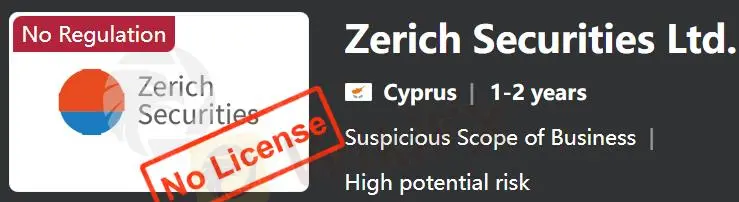
Review Mind Money’s 2026 CySEC license suspension, Russian securities fraud probe, client asset-return rules and key regulatory checks for forex, CFD and cross-border investors.
Mind Money License Suspended in June 2026
In June 2026, the Cyprus investment firm Mind Money Limited entered a period of overlapping regulatory and criminal-investigation scrutiny. Public information shows that Mind Money Limited was formerly known as Zerich Securities Ltd and held Cyprus Investment Firm license 115/10, dated February 22, 2010. By June 2026, the company had held the license for more than 16 years.
(Sources:CySEC,Mind Money Limited register page, checked: 2026-06; CySEC,Mind Money Limited license suspension decision, published: 2026-06-23.)
On June 23, 2026, CySEC issued a decision announcing the suspension of Mind Money Limited’s Cyprus Investment Firm license. The regulatory document shows that the suspension decision involved client-protection risks and risks to the orderly operation of the market. CySEC also required the company to take the necessary measures within one month to comply with the relevant authorization conditions.
Regulatory Decision Listed Four Main Issues
CySEC did not directly mention the Russian criminal investigation in its decision document, but instead listed issues from the perspective of the company’s authorization conditions and governance structure. According to the announcement, the main regulatory concerns included the following four points:
The company was suspected of engaging in activities outside the scope of its licensed authorization.
Changes to the company’s board of directors were not notified to CySEC as required.
The company failed to continuously meet the requirement that at least two effective managers actually direct the business.
The suitability of the company’s shareholders came under regulatory scrutiny.
During the license suspension period, Mind Money Limited may not provide or perform investment services or investment activities, may not enter into new business transactions with any person, may not accept new clients, and may not advertise itself as an investment service provider. The regulatory document also states that, in accordance with the wishes of existing clients, the company may complete transactions for existing clients and return funds and financial instruments belonging to clients.
Mind Money Is Not a Standard Forex Platform Case
According to Mind Money’s official website, the company mainly provides market services related to stocks, exchange-traded funds, bonds, initial public offerings, and pre-IPO investments. The CySEC register page also lists its investment and ancillary services, including reception and transmission of orders, execution of orders on behalf of clients, portfolio management, safekeeping and administration of financial instruments, and foreign exchange services related to investment services.
Therefore, when reporting on this incident, it would be inappropriate to simply classify Mind Money as an ordinary forex orCFDbroker. A more accurate description is that it is a CySEC-regulated Cyprus investment firm, and its license suspension is relevant for traders concerned about the safety of forex, CFD, and cross-border investment platforms.
Russian Investigation Involves RUB 7 Billion Securities Fraud Allegations
The Russian investigation is a key reason why this incident has drawn market attention. In mid-June 2026, Russian law-enforcement authorities alleged that Mind Money-related executives and their associates were suspected of participating in a fraud case involving shares and depositary receipts of Russian companies, with losses exceeding RUB 7 billion.
(Sources: Finance Magnates,Cypriot Broker Executives Arrested in Moscow over Alleged RUB 7 Billion Fraud, published: 2026-06-19; Finance Magnates,CySEC Suspends Mind Money's Licence Weeks After Russian Arrests of Its Executives, published: 2026-06.)
Investigation Focuses on Conversion of Frozen Depositary Receipts
Public reports citing information from Russia’s Federal Security Service stated that the suspects were accused of using forged documents to convert frozenADRs into shares of Russian listed companies, causing significant losses. The reports also stated that the investigation involved shares of Russian telecommunications, fuel, and energy companies, as well as provisions under Russia’s counter-sanctions laws restricting the circulation of foreign depositary receipts.
According to public reports, Russian law-enforcement officers conducted searches at related residential and office locations in Moscow and St. Petersburg, seizing communication devices, company seals, documents, digital media containing cryptocurrency wallets, and more than RUB 100 million in cash. The reports also stated that three suspects had been detained and two suspects had been placed under house restrictions.
Company Response Emphasized the Presumption of Innocence
In its public response, Mind Money acknowledged that its chief executive officer was subject to relevant actions in Russian investigation proceedings, but the company emphasized that the presumption of innocence should be followed and stated that it would be inappropriate to assess the facts of the case before the investigation process was completed. This response is not equivalent to confirmation of the allegations in the Russian investigation, nor does it replace CySEC’s regulatory conclusions.
The company stated that the relevant investigation should be viewed under the principle of presumption of innocence, and that it would be inappropriate to assess the circumstances of the case before the investigation process is completed.
From a factual news perspective, the Russian criminal investigation and CySEC license suspension occurred close together in time, but the CySEC announcement itself did not directly base the license suspension on the Russian case. The core wording of the regulatory document still centered on authorization conditions, corporate governance, client protection, and market-order risks.
| Date | Entity | Public Information | Impact |
|---|---|---|---|
| February 22, 2010 | CySEC | Mind Money Limited obtained Cyprus Investment Firm license No. 115/10. | The company established a licensed operating status under the EU regulatory framework. |
| Mid-June 2026 | Russian law-enforcement authorities | Related executives and associates were accused of involvement in a RUB 7 billion securities fraud case. | The company and the stability of its governance came under cross-border market attention. |
| June 19, 2026 | Finance Magnates | Reported details of the Russian investigation, including frozen ADR conversion, searches, and cash seizures. | The incident expanded from a regional criminal investigation into a matter of international financial-market concern. |
| June 23, 2026 | CySEC | Suspended Mind Money Limited’s CIF license and required remediation within one month. | The company may not conduct new investment services, accept new clients, or advertise investment services. |
CySEC Restricts New Business and Requires Return of Client Assets
The most direct impact of CySEC’s suspension decision on clients is that it restricts Mind Money Limited from continuing to conduct new business, while allowing room to handle existing client matters under specific conditions. The regulatory document shows that during the license suspension period, the company may not provide investment services, accept new clients, enter into new business transactions, or advertise itself as an investment service provider.
(Source: CySEC,Mind Money Limited license suspension decision, published: 2026-06-23, concerning restrictions during the license suspension period and arrangements for returning client funds.)
Existing Clients Need to Focus on More Than Whether Trading Is Available
For existing clients, a license suspension does not only mean that the platform stops new business. The more important questions are whether pending orders, account positions, safekeeping of financial instruments, fund returns, and withdrawal arrangements can continue within the scope permitted by the regulator. The CySEC document clearly states that, in accordance with the wishes of existing clients, the company may complete transactions already in progress for clients and return funds and financial instruments belonging to them.
This means clients should focus on checking whether their accounts have unsettled trades, incomplete settlements, cash balances awaiting return, or arrangements for the transfer of financial instruments. If the company requests additional documents, clients should require it to explain the legal basis, processing timeline, and next steps through formal email or system notification.
Platform Risk Checks Should Start With the Regulated Entity
The Mind Money incident shows that licensed operation does not mean a company will never encounter governance issues. However, when a licensed institution faces risks, regulators can usually publicly disclose restrictions and require the company to handle client assets according to rules. By contrast, when a completely unregulated platform experiences withdrawal delays, backend disconnection, or account abnormalities, investors often find it much harder to identify an effective complaint path.
Check whether the platform is still listed in the regulator’s public register, rather than relying only on promotional claims on the platform’s website.
Check whether the license status is normal, suspended, revoked, renounced, or under review.
Check whether the account-opening entity name, contracting entity, payment-receiving entity, and trading backend entity are consistent.
Check whether the platform has been subject to regulatory penalties, warnings, business restrictions, or license suspension decisions.
Keep complete materials such as account balances, withdrawal requests, trading records, customer-service emails, and system notifications.
Forex and CFD Traders Should Reassess Platform Account-Opening Risks
For forex and CFD traders, the lesson from the Mind Money incident is not whether one particular institution has already been finally characterized by authorities, but that platform risk often appears through multiple signals at the same time, including executive investigations, governance-structure changes, regulatory-status changes, rising client complaints, slower withdrawal processes, and opaque customer-service replies.
When choosing cross-border platforms, traders should treat regulatory checks as a basic step. Public registers, enforcement notices, and license-status updates from mainstream regulators usually reflect real risks better than platform advertisements and marketing materials. In particular, when information such as “license suspension,” “business restriction,” “undisclosed director changes,” or “shareholder suitability concerns” appears, account holders should promptly verify their funds, positions, and withdrawal availability.
Regulatory Licenses Cannot Replace Continuous Checks
Regulatory licenses can improve platform transparency and accountability, but they cannot eliminate all operational risks. Established firms may also face regulatory restrictions due to governance, compliance, shareholder structure, management changes, or cross-border legal issues. Therefore, traders should not look only at a platform’s founding date or historical marketing claims, but should pay attention to the latest regulatory status and recent public risk events.
In this case, CySEC’s announcement provided a clear regulatory signal: Mind Money Limited’sCIFlicense was suspended in full, and the regulatory concerns were directly related to client-protection risks. Such information is sufficient to remind account holders to pay close attention to account security, fund arrangements, and follow-up communication.
Questions Related to Mind Money’s License Suspension
When did Mind Money obtain its CySEC license?
The CySEC register page shows that Mind Money Limited, formerly known as Zerich Securities Ltd, holds license number 115/10, dated February 22, 2010. By June 2026, the company had held the license for more than 16 years.
Why did CySEC suspend Mind Money’s license?
The reasons listed in CySEC’s announcement include suspected activities outside the authorized scope, failure to notify the regulator of board changes, failure to continuously meet the requirement for two effective managers, and concerns over shareholder suitability. The regulator also mentioned client-protection and market-order risks.
Is the Russian investigation the same as the basis for CySEC’s action?
They cannot be directly equated. The Russian investigation involves criminal allegations, while CySEC’s announcement mainly focuses on the company’s authorization conditions and governance issues. The two occurred close together in time, but the CySEC announcement did not directly base the license suspension on the Russian case.
What should existing clients focus on during the license suspension?
Existing clients should focus on account balances, open orders, safekeeping of financial instruments, withdrawal requests, and official platform notices. The CySEC document shows that, in accordance with the wishes of existing clients, the company may complete relevant transactions and return funds and financial instruments belonging to clients.