Learn how FM Intelligence Volume Rank tracks forex and CFD broker trading volume, platform usage, active accounts, verification standards, and regulatory factors for market analysis.
Finance Magnates published an article titledFM Intelligence Volume Rank: History, Present and Futureon 2026-05-21, explaining the development process, data verification methods, and future expansion plans for itsFMIntelligence Volume Rank. The ranking mainly serves the forex andCFDbroker market, focusing on metrics such as broker trading volume, platform usage, account activity, and trading instrument structure.
The report shows that in the second quarter of 2026, two newFXand CFD brokers applied to join the volume ranking, and both companies are undergoing metric verification. Finance Magnates stated that all newly added brokers must provide independent verification materials for their trading volume, usually sourced from third-party technology providers working with the brokers.
“Every new broker added to our ranking is required to provide independent verification of its volumes.”
Volume Rankings Move from Industry Estimates to Verified Data
Finance Magnates stated in the article that its earliest traceable Intelligence Report archive dates back to the fourth quarter of 2012, while the first version of the volume ranking was launched in 2011. This timeline means that the Finance Magnates Volume Rank has covered the main stages of rapid expansion in the modern retail forex and CFD industry.
When the ranking was launched, the over-the-counter market had long lacked the public transparency seen in exchange-traded markets.OTCproducts are not matched on centralized exchanges, making it difficult for market participants to uniformly verify the trading scale disclosed by different brokers. Finance Magnates positioned the volume ranking as an industry benchmark, aiming to provide brokers, technology providers, payment companies, compliance teams, and researchers with the same set of comparable data.
Ranking Expansion Is Linked to Industry Transparency
According to the original article, Finance Magnates classifies the sources of its volume ranking into three categories: verified, published, and estimated. These three source types differ in credibility, disclosure channels, and use cases, which also determines how the ranking should be interpreted in subsequent use.
Verified data: Brokers submit metrics directly to Finance Magnates and provide documents supporting the authenticity of their trading volume.
Published data: Brokers disclose trading volume through their official websites, financial reports, or other official reports, and Finance Magnates includes such data in its statistics.
Estimated data: For brokers that do not disclose metrics, Finance Magnates makes estimates based on industry trends, visibility, and statistical models.
Finance Magnates also explained that the estimation process may differ from brokers’ actual metrics. Its latest requirement is that brokers meeting scale and legitimacy requirements may join the ranking, but new entrants must complete independent trading volume verification.
Platform Metrics and Trading Instruments Become New Areas of Observation
In 2019, Finance Magnates began adding more broker activity metrics to the volume ranking, including trading volume executed across different trading platforms. This adjustment enabled it to track changes in the use ofMT4andMT5, as well as compare trading activity between mobile and desktop platforms.
In 2025, Finance Magnates also added a “most popular trading instruments” ranking to the volume section, showing the instrument categories most actively traded by CFD clients by trading volume. The relevant categories include metals, forex, equities, and indices. This metric allows brokers to observe client preferences through the structure of trading volume, rather than relying solely on total volume to assess market position.
| Time | Milestone | Data or Mechanism Involved | Source Note |
|---|---|---|---|
| 2011 | First version of the volume ranking launched | Used to compare forex and CFD broker trading volume | Finance Magnates, 2026-05-21 |
| Q4 2012 | Earliest available Intelligence Report archive | Became a historical reference for subsequent quarterly industry data reports | Finance Magnates, 2026-05-21 |
| 2019 | Platform-level metrics added | Began tracking trading activity on MT4, MT5, mobile, and desktop platforms | Finance Magnates, 2026-05-21 |
| 2025 | Popular trading instrument ranking added | Covered instrument categories such as metals, forex, equities, and indices | Finance Magnates, 2026-05-21 |
| Q1 2026 | Retail FX and CFD active accounts expanded | Active accounts reached 7.42 million, while some leading brokers exceeded USD 1.5 trillion in monthly trading volume | Finance Magnates, 2026-04-30 |
| 2026-05-21 | Verification of new brokers underway | Two new brokers applied to join, both in the metric verification stage | Finance Magnates, 2026-05-21 |
Third-Party Verification Becomes an Entry Requirement for New Brokers
Finance Magnates stated in its 2026-05-21 report that new brokers joining the volume ranking must provide independent verification. This verification is usually presented in the form of a statement from a third-party technology provider, with the article citing providers including oneZero, Centroid, and FXCubic.
This mechanism is not limited to newly added brokers. Finance Magnates stated that brokers already included in the ranking may also be required to undergo the same verification process if the trading metrics they submit during a certain period deviate significantly from broader industry trends. The news significance of this arrangement is that the volume ranking no longer relies only on voluntary broker disclosure, but also cross-checks data through technology vendors, algorithmic review, and other datasets.
Brokers submit trading volume and related activity metrics to Finance Magnates.
Third-party technology providers issue statements verifying the source and verifiability of the trading volume data.
Finance Magnates uses algorithmic review to examine submitted data and cross-checks it against third-party records.
If the data is inconsistent with market activity, platform visibility, or industry trends, the relevant metrics may be re-examined.
Regulatory Environment Affects Trading Volume Scale
Trading volume alone cannot represent a broker’s overall market position. Finance Magnates noted in the report that the regulatory environment, client structure, leverage levels, acquisition methods, and regional market practices all affect final trading volume. In more strictly regulated markets such as Europe and Australia, restrictions are placed on retail client leverage and marketing methods, making it harder for brokers to rapidly scale trading volume through high leverage.
Public regulatory materials show that the European Securities and Markets Authority set the retail client leverage limit for major currency pairs at 30:1 in its CFD product intervention measures, with lower limits for other asset classes. The Australian Securities and Investments Commission’s CFD product intervention order, implemented from 2021-03-29, also limited retail leverage for major currency pair CFDs to 30:1, while introducing negative balance protection and margin close-out arrangements.
By contrast, some offshore jurisdictions impose fewer leverage restrictions. In the original article, Finance Magnates used a licensing combination involving the United Kingdom, France, and Vanuatu as an example to explain that the same broker may achieve higher trading volume if it serves clients through less restrictive markets. This example is used to illustrate the impact of regulatory structure on trading volume data and does not constitute an evaluation of any specific license or trading method.
Differences in Regional Market Structure Still Affect Rankings
In addition to regulatory factors, regional trading habits also affect trading volume. Finance Magnates mentioned that the Chinese market had long featured a structure in which clients opened accounts through introducing brokers, and some introducing brokers also managed the related accounts. This model may increase account trading frequency and cause trading volume in certain regional markets to be higher than under a standard retail account structure.
A high-leverage environment may amplify trading volume per account, but it also increases risk exposure.
Strong regulatory frameworks in mature markets typically restrict retail client leverage and broker marketing practices.
Client growth, platform migration, and regional agent models in developing markets can change the distribution of trading volume.
Whether brokers publicly disclose data will affect the proportion of “published” and “estimated” categories in the ranking.
Portal-Based Data Drives the Expansion of Ranking Functions
Finance Magnates publishedFinance Magnates Launches FM Intelligence: Data and Compliance Portalon 2026-03-23, introducing the FM Intelligence Portal. The portal brings market data, compliance tracking, and customized research together on one platform, with functions including broker trading volume, platform comparisons, market heat maps, regulatory updates, and risk signals.
After the portal launch, the volume ranking is no longer just a static table in quarterly reports, but is gradually moving toward a searchable, comparable, and scalable data product. Finance Magnates stated in its 2026-05-21 article that the ranking will cover more market participants that meet scale and legitimacy requirements, while adding broker characteristics, reporting metrics, and other trading data points.
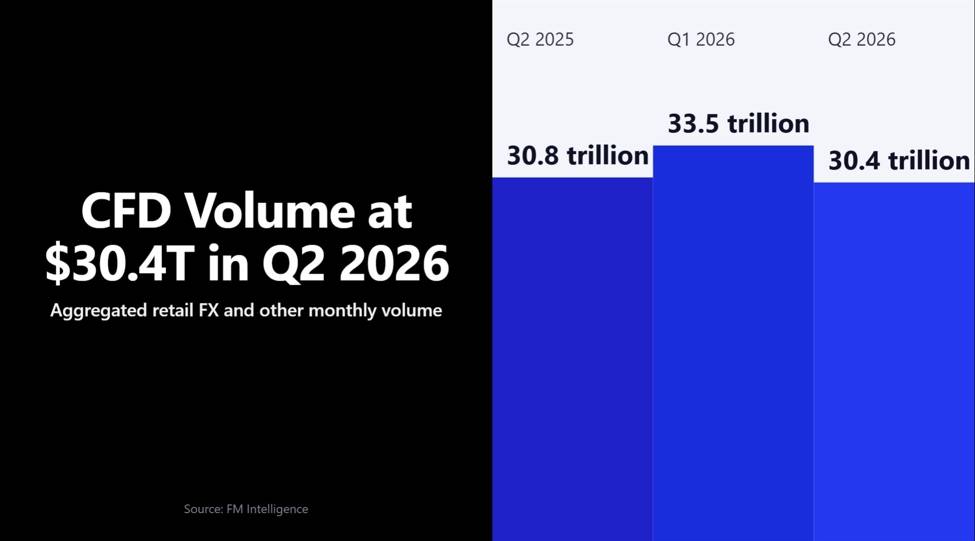
Industry data for the first quarter of 2026 also shows a practical basis for ranking expansion. Relevant Finance Magnates reports show that active accounts among the retail FX and CFD brokers it covers reached 7.42 million in Q1 2026; in the same quarter, some leading brokers exceeded USD 1.5 trillion in monthly trading volume, while the top-ranked broker surpassed USD 2 trillion for the first time. Trading volume growth outpaced account growth, increasing industry demand for data verification and comparability.
MT5 Platform Changes Increase the Importance of Platform Tracking
Platform-level data has also become an important variable in data reporting. Finance Magnates stated in its 2025-04-17 articleExclusive: MT5 Overtakes MT4 in Trading Volume After 15 Years, Signaling the End of an Erathat MT5 surpassed MT4 in the trading volume ranking. This shift shows that broker volume statistics need to distinguish platform sources; otherwise, they cannot identify client migration and changes in technology stacks.
In subsequent data products, FM Intelligence places trading volume, active accounts, platform share, mobile and desktop usage, trading instrument categories, and compliance signals within the same analytical framework. For brokers, this framework helps assess whether competitors’ growth comes from client numbers, client trading intensity, platform migration, or regional market changes.
Industry Data Competition Enters the Verification Stage
Finance Magnates stated in its 2026-05-21 article that its goal remains to improve and maintain industry transparency. As the retail FX and CFD market expands, the core debate around volume rankings has also shifted from “whether to disclose” to “how to verify.” Public rankings that lack verification mechanisms are vulnerable to self-reported data, estimation bias, and regional structural differences.
Based on currently disclosed information, the future expansion of FM Intelligence will focus on three areas: including more legitimate brokers with sufficient scale; improving the level of verification; and adding broker profiles beyond trading volume. This change will gradually transform the ranking from a single volume table into data infrastructure covering market, platform, client, and compliance dimensions.
This article is an industry information summary and does not constitute trading or investment advice. When interpreting broker volume rankings, readers should also consider data sources, verification status, regulatory environment, and client structure, and should not judge broker quality based solely on trading volume.
FAQs on the FM Intelligence Volume Rank
What does the FM Intelligence Volume Rank mainly measure?
The ranking mainly measures trading volume among forex and CFD brokers and is gradually expanding to include active accounts, platform usage, mobile and desktop trading, trading instrument categories, and broker characteristics.
Why do newly added brokers need to submit independent verification?
Because the over-the-counter market lacks centralized exchange data, relying solely on broker self-reporting may affect comparability. Independent verification can improve the credibility of trading volume data through third-party technology provider statements, algorithmic review, and cross-checking against other datasets.
Does high trading volume always mean a broker is stronger?
Trading volume only reflects the scale of trading activity and cannot represent a broker’s full market position on its own. The regulatory environment, client structure, leverage levels, trading instruments, and regional acquisition models all affect trading volume.
Why do regulatory leverage limits affect trading volume?
Leverage limits affect the notional trading scale available to clients. Europe and Australia set a 30:1 cap on retail CFD leverage for major currency pairs, so brokers in those markets generally find it harder to expand trading volume through high leverage.