Learn how price action trading uses candlestick patterns, trends, support and resistance, and multi-timeframe analysis to assess forex, CFD and market risks.
Why Price Action Trading Starts from Price Itself
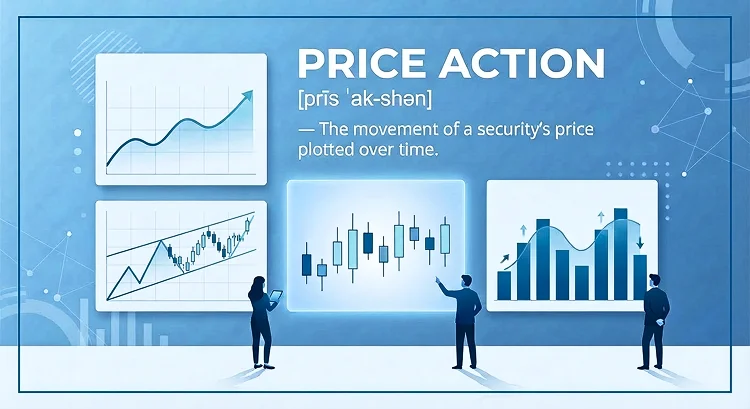
Price action trading, officially known as Price Action Trading and abbreviated asPAT, is a technical analysis method that mainly relies on changes in market prices. It focuses on the open, high, low, and close across different timeframes, as well as the trends, ranges, breakouts, pullbacks, false breakouts, and candlestick patterns formed by these prices.
Price action trading does not mean traders reject macro information. Rather, it assumes that most public information will eventually be reflected in price. Interest rate expectations, employment data, corporate earnings, risk sentiment, and capital flows all affect buying and selling pressure and leave traces on charts. By observing charts, traders try to identify how market participants react at key areas.
The advantage of this method is simplicity, while its drawback is subjectivity. Two traders looking at the same chart may give different interpretations of trendlines, support zones, or pin bars. Therefore, price action analysis must be combined with clear rules, such as observing patterns only at key locations, acting only when multiple timeframe directions align, and accepting only plans with quantifiable risk-reward ratios.
Historical Background and Theoretical Sources
Price action trading is closely related to traditional technical analysis.Dow Theory, developed from the late 19th century to the early 20th century, emphasized market trends, primary trends, and secondary reactions, laying the foundation for later trend identification. Japanese candlestick charts were used even earlier to record rice market price movements. Modern Western traders’ broad awareness of candlestick charts is largely associated with Steve Nison’s 1991 bookJapanese Candlestick Charting Techniques.
After the 1970s, theEfficient Market Hypothesissystematically explained by Eugene Fama reminded traders that public information may be quickly reflected in prices, and that consistently outperforming the market over the long term is not easy. Price action trading does not deny this. Instead, it focuses on identifying short- or medium-term structures with controllable risk. It is concerned with probabilistic advantage rather than absolute prediction.
| Source Dimension | Key Parameter | Applicable Scenario | Main Risk |
|---|---|---|---|
| Dow Theory | Primary trend, secondary trend, trend confirmation | Judging market direction and trend stage | Trend confirmation usually has a lag |
| Candlestick techniques | Body, shadows, open-high-low-close | Observing buying and selling pressure within a single period | A single candlestick can easily be overinterpreted |
| Support and resistance theory | Historical reaction zones, breakouts, and retests | Identifying potential reversal or pause areas | Market volatility may cause false breakouts |
| Risk management framework | Position size, stop-loss, spread, slippage | Controlling account drawdown and execution deviation | Lack of discipline can weaken any chart-based edge |
The Core of Naked Chart Analysis Is Not Reducing Information, but Reducing Noise
Why Too Many Indicators Can Affect Judgment
Many technical indicators are derived from price itself, such as moving averages, the Relative Strength Index, officially known as Relative Strength Index and abbreviated asRSI, and the Moving Average Convergence Divergence, officially known as Moving Average Convergence Divergence and abbreviated asMACD. These indicators help quantify trend and momentum, but most of them smooth raw price data, so lag may occur.
Naked chart traders prefer to observe price itself first and then decide whether auxiliary tools are needed. The more indicators there are on a chart, the greater the possibility of conflicting signals. For example, price may have already broken above a previous high, while an oscillator shows overbought conditions; or price may be pulling back within an uptrend, while a short-term indicator shows a sell signal. Without a primary-secondary framework, traders can easily be pulled back and forth by multiple signals.
Trend Structure Is More Important Than a Single Pattern
The core of price action is not memorizing the names of many candlestick patterns, but understanding where they appear. A pin bar appearing in the middle of an uptrend does not have the same meaning as one appearing at a long-term resistance zone. An outside bar occurring during a major data release is also different in reference value from one occurring at the end of a low-volatility consolidation.
Trend structure usually includes higher highs, higher lows, lower highs, and lower lows. In an uptrend, price continuously forms higher highs and higher lows. In a downtrend, price continuously forms lower highs and lower lows. If highs and lows lack direction, the market is closer to a ranging structure.
Deeper Meaning of Major Price Action Patterns
Inside Bar and Volatility Contraction
An inside bar means that the current candlestick’s high and low are contained within the previous candlestick. This pattern is often understood as short-term volatility contraction, indicating that the market has not temporarily chosen a direction. In a trend, an inside bar may simply be a continuation consolidation. Near key support or resistance, an inside bar may also suggest accumulation before a breakout.
Outside Bar and Power Shift
An outside bar means that the current candlestick’s range exceeds that of the previous candlestick. If the outside bar closes clearly toward one direction, it indicates that one side gained an advantage during that period. A bullish outside bar has more reference value in a support zone, while a bearish outside bar has more reference value in a resistance zone, but traders still need to observe whether subsequent price action continues.
Marubozu, Pin Bar, and Shooting Star
A Marubozu candlestick is also known as a candle with little or no shadow. It has a relatively long body and short shadows, and is often used to observe short-term dominance in one direction. A pin bar has a long shadow and a small body, indicating that price once extended in one direction but was then pushed back. A shooting star usually has a long upper shadow, and if it appears in a resistance area after a rise, it may suggest increasing selling pressure above.
| Pattern Name | Key Parameter | Applicable Scenario | Main Risk |
|---|---|---|---|
| Inside bar | Current candlestick range is smaller than the mother candle | Volatility contraction, trend continuation, consolidation before breakout | Breakout direction is uncertain |
| Outside bar | Current candlestick covers the previous high and low | Power shift and reaction at key areas | More false signals during data-driven markets |
| Marubozu candlestick | Relatively long body with short shadows | Observing strong upward movement or weak downward movement | Exhaustion may occur near the end of a trend |
| Shooting star | Long upper shadow, small body, positioned relatively high | Observation at resistance zones or near the end of an uptrend | In a strong trend, it may only be a brief pullback |
Differences in Observing Price Action Across Instruments
Price action methods can be applied to forex, indices, commodities, stocks, and crypto-asset markets, but price structures differ across markets. The forex market is affected by interest rates, central bank policy, macroeconomic data, and international capital flows. Index markets are affected by constituent stocks, risk appetite, and trading sessions. Commodities such as gold and crude oil are affected by inventories, supply and demand, the U.S. dollar, and geopolitical events. Stock-based contracts for difference are affected by earnings reports, ex-dividend events, mergers and acquisitions, and suspension risks.
Contracts for difference, officially known as Contract for Difference and abbreviated asCFD, allow traders to settle profits and losses based on changes in the underlying price, but they are not the same as directly holding the underlying asset. When using CFDs to observe price action, traders need to consider leverage, margin, spreads, and overnight fees in addition to chart structure.
| Instrument Type | Key Parameter | Applicable Scenario | Main Risk |
|---|---|---|---|
| Major currency pairs | Spreads, trading sessions, interest rate expectations | Trendlines, support and resistance, and multi-timeframe analysis | Macroeconomic data may cause rapid breakouts |
| Stock indices | Opening gaps, constituent weighting, futures linkage | Intraday trends and range-breakout observation | Opening volatility may weaken short-term patterns |
| Gold and crude oil | Volatility, inventory data, safe-haven sentiment | Key-level reactions and breakout retests | Longer shadows and higher slippage risk |
| Stock-based CFDs | Earnings reports, ex-dividend events, corporate events | Gaps, trend continuation, and support and resistance | A single company event may change the structure |
How Multi-Timeframe Analysis Improves Structural Clarity
Price action trading commonly uses multi-timeframe analysis. Higher timeframes are used to judge the main direction, while lower timeframes are used to observe entry areas and execution details. For example, the daily chart can be used to judge the main trend, the 4-hour chart can be used to observe pullback structure, and the 1-hour or 15-minute chart can be used to identify local candlestick patterns. The purpose is not to use as many timeframes as possible, but to establish a clear primary-secondary relationship.
Different trading styles suit different timeframes. Scalpers may focus on 1-minute to 15-minute charts, but they need to tolerate higher noise and more frequent spread impact. Intraday traders often focus on 15-minute to 4-hour charts. Swing traders usually value 4-hour, daily, and weekly charts. Long-term investors are more suited to observing daily, weekly, and monthly structures.
Short-term timeframes generate more signals, but they also have more false breakouts and noise.
Long-term structures are more stable, but entry signals are fewer and stop-loss distances are usually larger.
When multiple timeframe directions align, the trading plan is easier to quantify.
When timeframes conflict, position size should be reduced or traders should wait for the structure to become clearer.
Limitations and Risks of Price Action Trading
The biggest limitation of price action trading is subjectivity. Where support should be drawn, whether a trendline is valid, and whether a pin bar is clear enough are all affected by trader experience. To reduce subjective errors, traders should establish rule-based standards, such as requiring patterns to appear at key locations, confirming candlestick closes, setting a risk-reward ratio no lower than the preset level, and avoiding new plans before major events.
Another risk comes from oversimplification. Price does contain a great deal of information, but that does not mean traders can ignore the economic calendar, liquidity changes, and trading costs. Especially in leveraged CFD trading, even if the directional judgment of a price action signal is reasonable, excessive position size, spread widening, or slippage may still lead to unfavorable outcomes.
Price Action Trading FAQs
Why does price action trading emphasize naked charts?
Naked charts can reduce the visual interference caused by stacked indicators, allowing traders to observe trends, support and resistance, breakouts, and candlestick structure more directly. But naked charts do not mean completely rejecting auxiliary tools; the key is to keep the analytical hierarchy clear.
Is price action suitable for all trading instruments?
Price action can be used across multiple instrument types, but parameters cannot be copied directly. Forex, indices, commodities, and stock-based CFDs differ in trading sessions, volatility, spreads, and event risks.
Does an inside bar always lead to a breakout?
Not necessarily. An inside bar indicates volatility contraction, but the breakout direction and sustainability need confirmation from subsequent price action. If it appears during a low-liquidity period, signal reliability may decline.
Does multi-timeframe analysis work better with more timeframes?
No. Too many timeframes can create information conflicts. A common approach is to use one higher timeframe to judge direction, one middle timeframe to observe structure, and one lower timeframe to execute the plan.