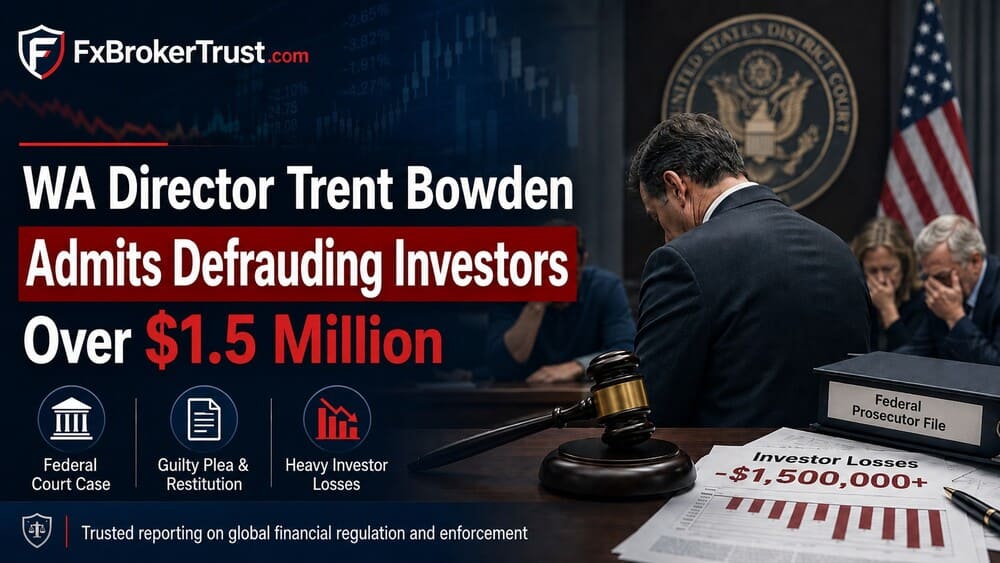
Former WA director Trent Bowden pleaded guilty to misusing over A$1.5 million in investor funds, highlighting forex investment fraud risks, director duties, ASIC enforcement, and investor remedies.
Former WA Company Director Bowden Admits Misusing Over A$1.5 Million in Investor Funds
On June 26, 2026, former company director Trent Bowden of Seville Grove, Western Australia, appeared before the Perth Magistrates Court and pleaded guilty to three charges of dishonestly using his position as a company director to gain a personal advantage. The prosecution was brought by the Commonwealth Director of Public Prosecutions (CDPP). The case is scheduled to return to the Perth Magistrates Court on August 21, 2026, for a sentencing hearing.
(Source: Mirage News, WA Director Trent Bowden Admits $1.5M Investor Fraud, published: 2026-06-26.)
Core Facts of the Case: Funds Raised for Forex Trading Were Used for Personal Expenses and Payments to Other Investors
The three charges Bowden admitted all involved breaches of section 184(2)(a) of theCorporations Act 2001(Cth), namely dishonestly using his position as a company director to gain an advantage for himself. The maximum penalty for each offence is 15 years’ imprisonment.
According to the prosecution allegations, between March 13, 2019, and November 1, 2023, Bowden raised more than A$1.5 million from investors through his company, Trent Bowden Trading Pty Ltd. During the fundraising process, Bowden told investors that the funds raised would be invested mainly through forex trading. However, Bowden used his position as company director to misappropriate investor funds. The actual use of funds included the following:
Personal consumption expenses: investor funds were used for Bowden’s own daily spending and personal financial needs, rather than being invested in the forex market as promised.
Payments to other investors: part of the funds was used to pay so-called “returns” to other investors. This pattern closely resembles the funding mechanism of a Ponzi scheme, where money from new investors is used as returns for earlier investors.
Other non-trading purposes: the remaining funds were directed to other channels entirely unrelated to forex trading.
Timeline of the Company Involved
Public notice records from the Australian Securities and Investments Commission (ASIC) show that Trent Bowden Trading Pty Ltd (ACN617 582 626) was incorporated in 2017. During its operation, the company underwent several major regulatory and legal process changes:
| Date | Event | Legal Basis | Status Change |
|---|---|---|---|
| 2017 | Company incorporated with ASIC | —— | Normally registered |
| May 14, 2019 | ASIC issued a proposed deregistration notice | Section 601AB(3) of the Corporations Act | Proposed deregistration (not later carried out) |
| November 8, 2023 | External administrators appointed | Voluntary administration process | Entered external administration |
| December 5, 2023 | Notice of second creditors’ meeting published | Section 75-40(1) of the Insolvency Practice Rules | Voluntary administration process ongoing |
| June 26, 2026 | Bowden pleaded guilty in the Perth Magistrates Court | Section 184(2)(a) of the Corporations Act | Criminal proceedings ongoing |
| August 21, 2026 | Sentencing hearing scheduled | —— | Awaiting judgment |
Legal Background: Criminal Liability Imposed on Company Directors Under Section 184 of theCorporations Act
Section 184(2)(a) of theCorporations Act 2001(Cth), which Bowden breached, is a core criminal provision in Australia’s corporate law framework targeting dishonest conduct by company directors, officers, and employees. The provision states that a company director, other officer, or employee commits a criminal offence if they dishonestly use their position with the intention of directly or indirectly gaining an advantage for themselves or someone else, or causing detriment to the company.
The key legal elements of this provision include:
The person must be a company director, officer, or employee.
The person must have dishonestly used their position.
The person must have intended to gain an advantage for themselves or someone else, or cause detriment to the company; or have been reckless as to those outcomes.
Under the penalty provisions in Schedule 3 of theCorporations Act, the maximum penalty for breaching section 184(2)(a) is 15 years’ imprisonment. As the enforcement agency for the Act, ASIC is responsible for bringing legal proceedings against company officers who breach directors’ duties or referring cases to federal prosecutors. In addition, under section 206C of theCorporations Act, a court may also make an additional order disqualifying a director found to have breached their duties from managing corporations.
(Source: Corporations Act 2001 (Cth), Section 184(2)(a), Good faith, use of position and use of information — criminal offences.)
Investor Warning Significance of This Case
The Bowden case shows typical characteristics of forex investment fraud and deserves close attention from potential investors:
Investors were attracted with the promise of high returns from forex trading, but the funds were not actually invested in legitimate forex trading activities.
Part of the money from new investors was used to pay “returns” to earlier investors, creating the illusion that the investment was operating normally. This method is consistent with the cash-flow recycling mechanism of a Ponzi scheme.
During its operation, the company involved had faced an ASIC proposed deregistration process in 2019, but the process was not carried out. The company continued operating under the same name and kept receiving investor funds until it entered external administration in November 2023.
From the first fundraising activity in March 2019 to the company entering administration in November 2023, the fraudulent conduct lasted for four years and seven months, involving more than A$1.5 million.
Recent Australian Enforcement Trend Against Company Director Fraud
The Bowden case is not an isolated example. In recent years, ASIC has continued to intensify enforcement against company directors who breach their duty of loyalty. In January 2026, former fund manager Rodney Forrest was sentenced by the Federal Court in Sydney to six years’ imprisonment for insider trading. The case involved trading shares in Platinum Asset Management using illegally obtained confidential takeover documents, generating profits of more than A$300,000. After the judgment, ASIC Chair Joe Longo stated that prosecuting insider trading and corporate fraud is a long-term enforcement priority for ASIC and emphasized the agency’s determination to accelerate the handling of criminal cases.
(Source: ASIC, 26-007MR Fund manager sentenced to 6 years' jail in $3 million Platinum Asset Management insider trading case, published: 2026-01-23.)
Questions About Identifying Forex Investment Fraud
How can investors identify investment fraud conducted in the name of forex trading?
Typical forex investment fraud usually has the following features: promises of fixed or high returns without verifiable trading records; the fundraising entity does not hold a valid license issued by the financial regulator in the relevant jurisdiction; investors cannot directly access or monitor the actual trading status of their funds; and money from new investors is used to pay “returns” to earlier investors. Before committing funds, investors should verify whether the fundraising entity is registered with regulators such as ASIC and holds a valid Australian financial services license.
How strong are the obligations imposed on company directors under section 184 of Australia’sCorporations Act?
Section 184 is one of the most serious criminal provisions in theCorporations Act. It covers three types of conduct: dishonestly failing to act in good faith, dishonestly using one’s position, and dishonestly using information obtained through one’s position. Each offence carries a maximum penalty of 15 years’ imprisonment. The provision applies to company directors, officers, and employees. Even if the conduct objectively benefits the company, that cannot be used as a defence.
Through which channels can investors seek remedies after encountering similar fraud?
In Australia, investors may submit a formal complaint to ASIC, which has the authority to investigate suspected breaches of theCorporations Actand refer matters for prosecution. If the company involved enters external administration or liquidation, investors may participate in creditors’ meetings as creditors and lodge a proof of debt. In addition, investors may seek compensation through civil litigation before the courts.
What compliance qualifications are required to conduct forex trading business in Australia?
In Australia, companies providing forex trading services must hold an Australian financial services license (AFS Licence) issued by ASIC and must comply with regulatory requirements covering capital adequacy, client fund segregation, compliance governance, and periodic reporting. Providing relevant financial services without a valid AFS Licence is unlawful. Investors can use ASIC’s public register to check whether any company or individual holds a valid financial services license.