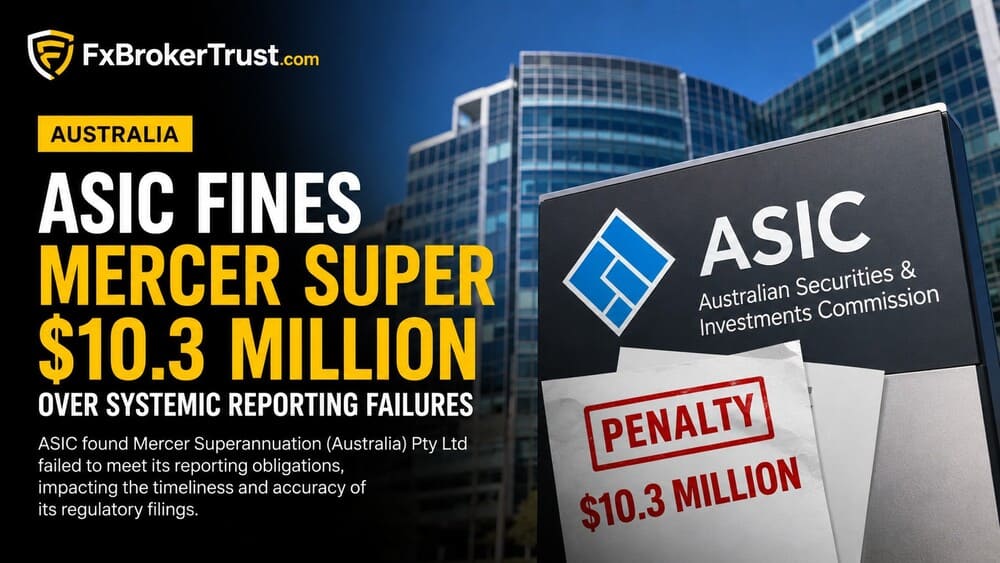
Mercer Super was fined A$10.3 million for systemic reportable situations failures, highlighting ASIC enforcement, member service risks, and compliance duties in Australia’s super sector.
Federal Court Orders Mercer Super to Pay A$10.3 Million Penalty
On June 29, 2026, the Federal Court of Australia ordered superannuation trustee Mercer Superannuation (Australia) Limited, hereinafter referred to as Mercer Super, to pay penalties totaling A$10.3 million. The judgment arose from Mercer Super’s systematic failure, between October 2021 and September 2024, to report internal investigations involving serious member service issues to the Australian Securities and Investments Commission (ASIC) under the “reportable situations regime” prescribed by theCorporations Act(Cth). The case involved 60 admitted contraventions.
(Source: ASIC, 25-166MR ASIC sues Mercer Super alleging systemic failure to report member services investigations, initially filed: 2025-08-14; Business News Australia / Super Review / Mirage News all reported the judgment outcome on 2026-06-29.)
Core Contraventions Found by the Court
Justice Button found that, over a three-year period, Mercer Super’s internal systems for complying with theCorporations Act“reportable situations regime” had fundamental deficiencies. The regime requires holders of Australian financial services licences to notify ASIC within 30 days when they conduct an investigation into conduct that may constitute a significant breach of core obligations. The specific contraventions found by the Court included:
Mercer Super completely failed to report seven internal investigations that were legally required to be reported to ASIC.
One further investigation was eventually reported, but the report was delayed by approximately one year.
In relation to the delayed report, Mercer Super failed to take all reasonable steps to ensure that the report submitted to ASIC was accurate. The report contained false or misleading information and understated the number of members affected by the matter under investigation.
Justice Button stated that, given the length of time over which Mercer Super’s investigations went unreported, ASIC’s regulatory function was seriously impaired. The judge also found that Mercer Super had previously been informed that its compliance systems were inadequate and that there was a risk that investigations would not be identified and reported to ASIC as required.
Member Service Issues Involved in the Unreported or Late-Reported Investigations
The internal investigations that Mercer Super failed to report on time, or failed to report entirely, involved several serious member service issues:
Failure to update member account information in a timely manner, resulting in affected members being charged higher fees and being subject to less favorable insurance policy terms.
Failure to allocate a total of A$64 million in member funds in a timely manner.
Failure to provide eligible members with death and total and permanent disability (TPD) insurance cover.
Continuing to charge insurance premiums after members had died, with refunds provided only after the fact.
ASIC Chair’s Response: Systemic Deficiencies Are Unacceptable
ASIC Chair Sarah Court said after the judgment that the systemic deficiencies and conduct identified were unacceptable for a superannuation trustee of Mercer Super’s size and market position.
"These failures undermined key safeguards designed to protect consumers and exposed fundamental flaws in Mercer Super’s systems and processes. This was not an isolated oversight, but an ongoing systemic issue that persisted years after the regime was introduced. For a fund entrusted with managing around A$80 billion in retirement savings for more than one million members, this is unacceptable."
Chair Court also stated that if investigations into serious member service issues are not reported to ASIC as required by law, problems affecting members may continue without regulatory oversight, increasing the risk of ongoing harm to members. She said the Court’s decision sent a clear message to the superannuation industry: accurate and timely regulatory reporting is not optional, and ASIC will take enforcement action against funds that fail to meet the standard.
(Source: Mirage News, ASIC Fines Mercer Super $10.3M for Reporting Failures, published: 2026-06-29; Super Review, Mercer Super fined $10.3m over reporting failures, published: 2026-06-29.)
Mercer Super Profile and Previous Penalty Record
Mercer Super is Australia’s seventh-largest superannuation fund by member numbers, with more than one million members and nearly A$80 billion in assets under management. In its response, Mercer Super acknowledged and apologized for failing to meet its obligations under the “reportable situations regime,” while emphasizing that the shortcomings were not deliberate, that Mercer Super did not obtain any financial benefit from them, and that ASIC did not allege that members suffered financial or non-financial loss as a result of the matter. The penalty will be paid at the Mercer corporate level and will not be borne by the superannuation fund or its members.
The A$10.3 million penalty is not the first ASIC penalty imposed on Mercer Super. In August 2024, Mercer Super was ordered by the Federal Court to pay an A$11.3 million penalty after admitting that it had made misleading statements about the sustainability and characteristics of certain superannuation investment options, known as “greenwashing.” That case was ASIC’s first greenwashing lawsuit.
| Penalty Date | Penalty Amount | Reason for Contravention | Case Number |
|---|---|---|---|
| August 2024 | A$11.3 million | Misleading environmental, social and governance statements about “Sustainable Plus” investment options, namely greenwashing | 24-173MR |
| June 29, 2026 | A$10.3 million | Systemic failure to report, or late reporting of, internal investigations involving serious member service issues, involving 60 contraventions | 25-166MR |
Industry Context: ASIC’s Systemic Enforcement Action in the Superannuation Sector
The Mercer Super case forms part of ASIC’s recent systemic enforcement action targeting member service failures in the superannuation industry. Holding superannuation trustees accountable for failures in member services has been listed as one of ASIC’s core enforcement priorities for 2026. The following are major recent related cases:
Cbus: A$23.5 Million Penalty (November 2025)
On November 25, 2025, the Federal Court ordered United Super Pty Ltd, the trustee of the Construction and Building Unions Superannuation fund (Cbus), to pay a penalty of A$23.5 million. The penalty related to serious failures in processing member death benefit and total and permanent disability insurance claims, which caused unreasonable delays for more than 7,000 Australian members and claimants. The penalty exceeded United Super’s total reported revenue for the 2024 financial year, which was A$18.5 million. In addition, Cbus launched a separate compensation program of approximately A$32 million to compensate affected members for lost returns and wrongly charged fees arising from the delays.
(Source: ASIC, 25-286MR Cbus ordered to pay $23.5 million penalty for serious failures in processing members death benefits and insurance claims, published: 2025-11-25.)
Telstra Super: Internal Dispute Resolution Failures (April–May 2026)
On April 30, 2026, the Federal Court found that Telstra Super, now renamed Tetra Servicing Pty Ltd, failed to comply with its internal dispute resolution procedures. The Court found that among complaints made between October 22, 2021, and January 13, 2023, approximately one-third did not receive a response within the statutory 45-day timeframe, and around 30% of delayed responses were more than 100 days late. The case was ASIC’s first enforcement proceeding under the strengthened internal dispute resolution regime that took effect in October 2021. Telstra Super completed its merger with Aware Super on April 30, 2026. The penalty hearing in this matter is ongoing.
(Source: ASIC, 26-091MR Federal Court holds Telstra Super accountable for internal dispute resolution failures, published: 2026-05-07.)
AustralianSuper: Death Benefit Claims Delay Lawsuit (Since March 2025)
In March 2025, ASIC commenced proceedings in the Federal Court against AustralianSuper Pty Ltd, the trustee of Australia’s largest superannuation fund, alleging delays in processing nearly 7,000 death benefit claims. In the same month, ASIC issued 34 improvement recommendations to all superannuation trustees, calling for improvements to the processes and timeliness of death benefit claims handling.
(Source: ASIC, 25-034MR and 25-049MR, published: March 2025.)
Legal Background of the “Reportable Situations Regime”
Australia’s “reportable situations regime” has been in force since October 2021. It requires all holders of Australian financial services licences to submit a report to ASIC within 30 days after commencing an investigation into conduct that may constitute a significant breach of core obligations. The regime’s core objectives include:
Enabling ASIC to identify misconduct by licensed entities at an early stage.
Ensuring that licensed entities prioritize investigation and remediation work.
Strengthening transparency and accountability across the financial services industry.
Under the relevant provisions of theCorporations Act, reports submitted by licensed entities must be accurate and complete and must not contain false or misleading information. Licensed entities that breach the reportable situations regime may face civil penalties imposed by the Federal Court.
Questions About Superannuation Regulation and Member Rights
What does Australia’s “reportable situations regime” require licensed entities to do?
Since October 2021, all holders of Australian financial services licences must notify ASIC within 30 days after commencing an investigation into conduct that may constitute a significant breach of core obligations. Reports must be accurate and complete and must not contain false or misleading information. Failure to report on time or submitting inaccurate reports may lead to enforcement action and civil penalties.
Will Mercer Super’s A$10.3 million penalty be borne by members?
Mercer Super stated that the penalty will be paid at the Mercer corporate level and will not be borne by the superannuation fund or its members. ASIC also did not allege in this case that Mercer Super’s contraventions caused members to suffer direct financial or non-financial loss. However, the contraventions objectively weakened ASIC’s ability to detect and intervene in issues at an early stage.
How can superannuation members check whether their fund has compliance issues?
Members can review media releases and enforcement action records published on ASIC’s official website to see whether a superannuation fund has publicly disclosed compliance issues or penalties. Members can also check complaint handling information relating to specific funds through the Australian Financial Complaints Authority (AFCA). ASIC’s Moneysmart website also provides consumer guidance on superannuation-related decisions.
What trend has ASIC’s enforcement in the superannuation sector shown in recent years?
Since 2024, ASIC has significantly increased enforcement activity in the superannuation sector, focusing on areas such as delays in death benefit claims, internal dispute resolution failures, deficiencies in regulatory reporting compliance, and misleading investment statements. Between 2025 and 2026, major superannuation trustees including Mercer Super, Cbus, Telstra Super, and AustralianSuper have faced Federal Court proceedings or penalties, with total penalties exceeding A$45 million. Holding superannuation trustees accountable for member service failures has been explicitly listed as one of ASIC’s core enforcement priorities for 2026.